
The security and welfare of students across Nigeria remain top priorities for citizens and educational stakeholders today. Recently, the Nigerian Senate took a decisive step to strengthen transparency and protect educational environments. Lawmakers officially expanded their ongoing legislative probe into the Safe Schools Initiative.
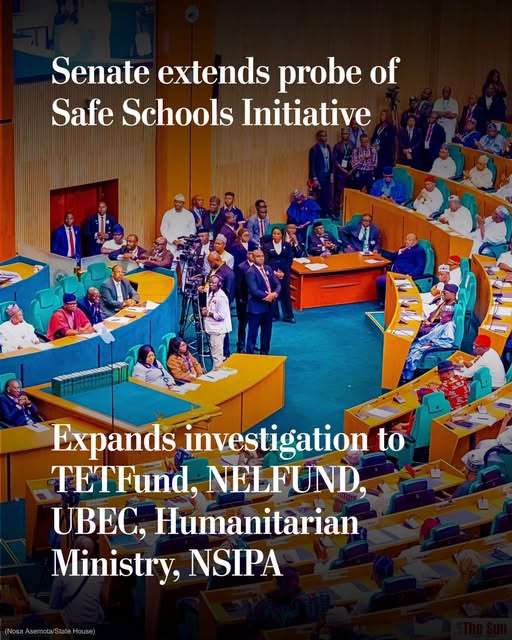
The upper chamber did not limit its scrutiny to the primary financing office alone. Instead, it broadened the investigative net to include major federal education and welfare agencies. Consequently, the public now witnesses a sweeping audit under the banner of the Safe Schools Initiative: TETFund, NELFUND, UBEC for investigation.
This major legislative expansion marks a turning point in how Nigeria monitors educational funds. We will examine why the Senate expanded this investigation, explore the roles of the added agencies, and analyze what this means for the future of Nigerian education.
The Origin of the Safe Schools Initiative Investigation
To understand the current legislative action, we must look at the history of the Safe Schools Initiative. The federal government launched the program to protect learning institutions from violent attacks and kidnappings. It operated as a partnership involving the government, the United Nations, and private sector stakeholders. The program specifically aimed to strengthen physical security infrastructure in schools located within conflict-prone communities.
However, persistent security challenges across the country forced lawmakers to ask tough questions. The Senate officially inaugurated an ad-hoc committee in December 2025 to investigate the initiative. Growing concerns over repeated attacks on educational institutions triggered this initial oversight action.
A tragic security breach in Kebbi State further accelerated the legislative inquiry. Armed bandits abducted twenty-five female students from Government Girls Comprehensive Secondary School, Maga. Sadly, the attackers killed the vice principal during the assault. This incident reignited nationwide outrage regarding the safety of students and teachers.
During preliminary hearings, lawmakers uncovered concerning financial discrepancies. The committee scrutinized the disbursement of fifteen billion Naira released for the program in 2023. Records showed that the Nigeria Police Force received over six billion Naira from that allocation. Furthermore, lawmakers queried alleged financial irregularities and consultancy payments associated with the program. Find out more here.
Why Lawmakers Expanded the Safe Schools Initiative Investigation
The investigation took a dramatic turn during a plenary session on Tuesday, July 21, 2026. The Chairman of the Ad-hoc Committee, Senator Orji Uzor Kalu, sponsored a critical motion. He moved the motion under Orders 41 and 51 of the Senate Standing Orders. He requested an expansion of the committee’s terms of reference and more time to complete the assignment.
Senator Kalu presented compelling arguments to his colleagues. He explained that preliminary investigations revealed deep connections between the Safe Schools Initiative and other federal agencies. These agencies handle education financing, student welfare, social investments, and humanitarian support.
Therefore, investigating the primary program in isolation would leave significant oversight gaps. Senator Kalu warned against fragmented legislative scrutiny. He stated that student security, infrastructure funding, and social intervention schemes are deeply interwoven.
Following his presentation, the Senate approved the expansion without opposition. Senate President Godswill Akpabio presided over the session and granted the committee’s requests after a unanimous voice vote. This approval officially brought TETFund, NELFUND, UBEC for investigation under the expanded mandate.
TETFund Under the Microscope: Auditing Tertiary Infrastructure
The inclusion of the Tertiary Education Trust Fund represents a major shift in the investigation. Lawmakers recognize that university and polytechnic campuses also face severe security threats. Consequently, the committee will scrutinize how TETFund allocates and monitors its security interventions.
Under the new mandate, the investigative panel will execute specific oversight tasks regarding TETFund:
- The committee will audit infrastructure and security-related intervention projects funded across beneficiary tertiary institutions.
- Lawmakers will evaluate the effectiveness of perimeter fencing projects and surveillance systems installed on campuses.
- The investigation will verify if contractors executed security projects according to technical specifications.
- The panel will assess financial flows and operational bottlenecks affecting project delivery in federal and state universities.
This scrutiny aims to ensure that infrastructure funds genuinely protect tertiary students and faculty members.
NELFUND on the Radar: Assessing Student Welfare and Loan Access
Many citizens wondered why an education loan agency joined a security investigation. However, lawmakers clarified that student welfare directly links to campus stability and security. The Nigerian Education Loan Fund currently manages billions of Naira designed to keep students in school.
The committee will examine NELFUND through several specific operational lenses:
- Lawmakers will assess the student loan disbursement processes across universities, polytechnics, and colleges of education.
- The panel will evaluate the operational readiness and administrative efficiency of the agency.
- The investigation will review the student access framework to ensure fair and transparent loan distributions.
- Lawmakers will verify accountability mechanisms governing the release of upkeep allowances to beneficiaries.
By investigating NELFUND, the Senate seeks to remove financial barriers that leave students vulnerable to economic desperation and exploitation.
UBEC and Basic Education: Protecting Nigeria’s Youngest Learners
Primary and junior secondary schools suffer the highest casualty rates during rural security breaches. Therefore, adding the Universal Basic Education Commission to the investigation addresses a critical vulnerability. UBEC manages intervention funds allocated to basic education across all thirty-six states.
The Senate panel will investigate UBEC operations using clear evaluative criteria:
- The committee will examine UBEC interventions in the basic education sector nationwide.
- Lawmakers will audit the deployment of matching grants intended for school rehabilitation and security upgrades.
- The investigation will review how state basic education boards utilize federal security allocations.
- The panel will assess collaboration levels between UBEC and local community security structures.
This thorough check ensures that basic education managers prioritize the physical safety of young children.
Beyond Education Bodies: The Role of Humanitarian Ministry and NSIPA
The Senate did not restrict its expanded probe to traditional education institutions. Lawmakers also included the Federal Ministry of Humanitarian Affairs and Poverty Alleviation. Furthermore, they added the National Social Investment Programme Agency to the list of institutions under scrutiny.
These humanitarian bodies play vital roles in educational continuity during emergencies. The ad-hoc committee will examine their activities through specific focus areas:
- Lawmakers will review social safety net allocations linked directly to school feeding programs.
- The panel will evaluate emergency relief interventions provided for displaced students in conflict zones.
- The committee will scrutinize educational rehabilitation initiatives administered through the humanitarian ministry.
- Lawmakers will check accountability structures governing funds meant for vulnerable learners.
This broader approach recognizes that poverty and displacement significantly worsen school insecurity across Nigeria.
The Three-Week Timeline: What Happens Next?
Expanding an investigation of this magnitude requires adequate time for thorough field execution. Senator Kalu explained that demanding legislative schedules previously delayed planned visits to critical locations. He noted that four key investigative areas remained incomplete.
Consequently, the Senate granted the ad-hoc committee a three-week extension to finish its work. During this extension period, the public should expect several high-level activities:
- The committee will conduct oversight visits to selected schools and project sites across the six geopolitical zones.
- Lawmakers will summon executive secretaries, directors general, and accounting officers of the affected agencies.
- The panel will demand reconciled financial statements, contractor lists, and bank transaction records.
- Lawmakers will compile a comprehensive report detailing their findings and recommendations for plenary presentation.
The Senate aims to produce actionable resolutions that will permanently reform education financing and security.
What This Investigation Means for Nigerian Education
This legislative audit holds massive implications for the future of schooling in Nigeria. For too long, government agencies operated in silos without coordinated accountability. Bringing the Safe Schools Initiative: TETFund, NELFUND, UBEC for investigation creates a unified standard of financial transparency.
First, the probe sends a strong message to public office holders. It proves that parliament will no longer tolerate administrative opacity in the management of intervention funds. Agency leaders must now demonstrate tangible results for every Naira spent on student welfare and security.
Second, the investigation protects educational infrastructure from corruption. When contractors realize that parliament will audit their projects, execution quality improves naturally. This shift leads to stronger perimeter walls, better solar lighting, and safer classrooms for students.
Finally, the probe reinforces public trust in government safety programs. Parents need reassurance before sending their children back to schools in vulnerable areas. A transparent, thorough legislative investigation provides the oversight necessary to restore faith in public education.
Conclusion
The decision by the Nigerian Senate to expand its ongoing probe represents a commendable display of legislative responsibility. By incorporating TETFund, NELFUND, UBEC for investigation alongside humanitarian agencies, lawmakers acknowledged a vital truth. True school safety requires a holistic approach that links infrastructure, security, loan access, and student welfare.
As the three-week extension runs its course, citizens and educational advocates must follow the proceedings closely. The outcome of this investigation must not end up on a dusty shelf. Instead, it must drive real reforms that protect classrooms, eliminate corruption, and guarantee a secure learning environment for every Nigerian child.
What are your thoughts on this expanded legislative probe? Do you believe investigating these education agencies will improve school safety across Nigeria? Share your opinions and experiences in the comment section below!
Recommended:
President Tinubu Upgrades Federal Polytechnic Nasarawa to a Specialized University
YEIDEP 2026: Recruitment, Registration, and Everything You Should Know Before You Apply
Do All Nigerian Universities Accept ND for Direct Entry? (What You Need to Know)