
Organic chemistry presents incredibly complex challenges to researchers worldwide. Scientists spend countless hours interpreting dense chemical data in laboratories. Now, a brilliant mind in Nigeria has built a powerful digital solution. A lecturer at the Federal University Gashua (FUGA), Yobe State, has created an innovative analytical tool. Zannah Zakariya Goni developed an artificial intelligence-powered platform to assist chemists. This technology promises to transform the way scientists analyse chemical structures globally. Furthermore, it offers a much faster and more efficient approach to a highly demanding research process. Today, the scientific community celebrates this new innovation, known as the ZZG Structure Elucidator.
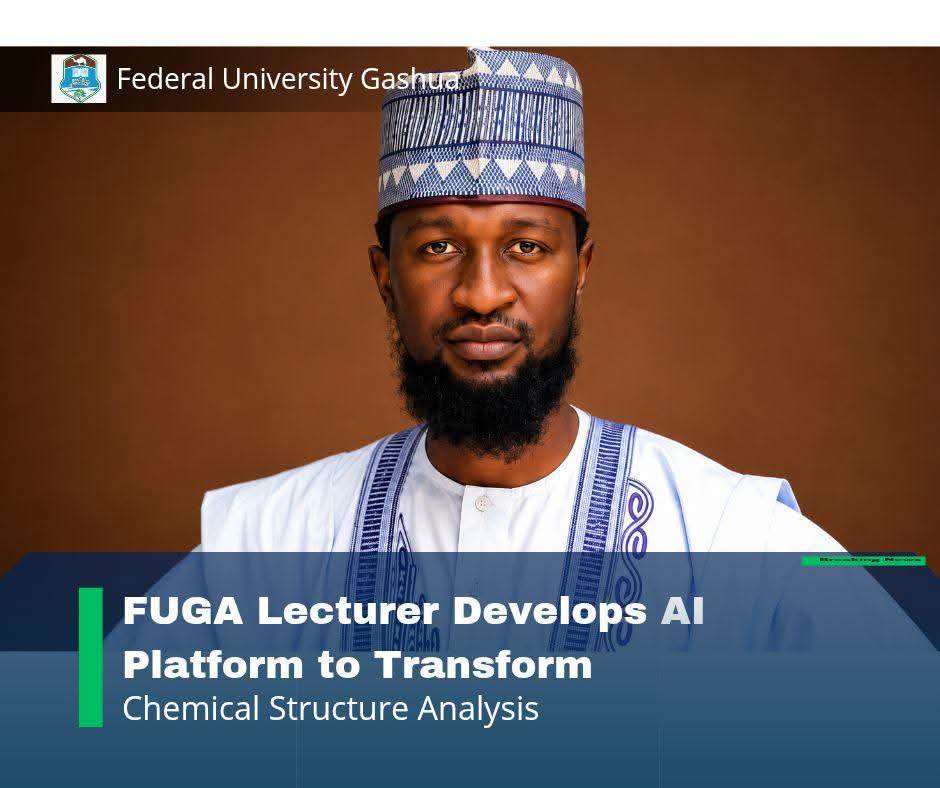
In this detailed blog post, we will explore the science behind this breakthrough. We will examine how the platform works and discuss its impact on academic research. Finally, we will look at how this achievement aligns with the broader vision of the Federal University Gashua.
The Breakthrough and National Recognition
Zannah Zakariya Goni recently gained massive recognition for his pioneering work. His groundbreaking platform earned a Bronze AI Judge Rating. He received this prestigious accolade under the Kanz AI Portfolio in July 2026. This achievement brings immense national pride to Nigeria. It highlights the growing drive for technological innovation within Nigerian tertiary institutions.
Furthermore, it places the Federal University Gashua on the global technology map. Securing a spot in the Kanz AI Portfolio proves the international viability of the project. The ZZG structure elucidator stands out as a highly practical solution to a universal scientific problem. It demonstrates how African researchers can leverage artificial intelligence to build globally relevant tools.
The Complexities of Organic Chemistry
To appreciate this innovation, we must first understand the problem it solves. Chemical structure analysis is notoriously difficult and time-consuming. Scientists typically rely on complex spectroscopic data to identify unknown compounds. They use methods like Nuclear Magnetic Resonance (NMR), Infrared Spectroscopy (IR), and Mass Spectrometry (MS).
Interpreting this data takes immense skill, deep knowledge, and extreme patience. A chemist must look at jagged lines on a graph and deduce a complex 3D molecular shape. Often, the data points overlap or present confusing signals. Consequently, manual structure elucidation often becomes the biggest bottleneck in chemical research. The ZZG Structure Elucidator directly targets and eliminates this specific bottleneck.
How the ZZG Structure Elucidator Works
Zannah Zakariya Goni designed his platform to be incredibly user-friendly. It operates as a highly advanced multimodal AI system. This means the software can process different types of information seamlessly.
Consequently, the platform accepts spectroscopic data in multiple formats. Researchers can input raw numerical data directly into the system. Alternatively, they can simply upload image files of their spectroscopic graphs. The AI platform processes this information rapidly and intelligently. It analyzes the available chemical data with absolute mathematical precision.
Then, it predicts the most likely molecular structure. Remarkably, the system performs exceedingly well even when datasets remain incomplete. Manual analysis usually stalls entirely when experimental data is missing. However, the ZZG Structure Elucidator bridges these informational gaps intelligently. It uses advanced machine learning algorithms to recognise complex chemical patterns. Therefore, it delivers accurate structural predictions in record time.
The Motivation Behind the Innovation
Every great invention stems from a desire to solve a pressing problem. Zannah Zakariya Goni shared the deep motivation behind his remarkable work. He strongly believes that technology must serve human progress first. According to him, artificial intelligence should act as an empowering tool for human beings.
Goni stated that AI must free scientists from tedious, repetitive analytical tasks. Manual interpretation of spectra consumes thousands of valuable research hours every year. By automating this tedious process, the ZZG Structure Elucidator gives precious time back to researchers. Goni envisions a future where scientists devote their energy entirely to actual discovery. They can focus purely on true innovation and high-level problem-solving rather than basic data entry.
Transforming the Academic Landscape
The benefits of this AI platform extend far beyond professional corporate laboratories. The ZZG Structure Elucidator provides massive advantages for university academics and students.
Traditionally, learning spectroscopic analysis frustrates many young chemistry students. The steep learning curve often discourages them from pursuing advanced organic chemistry. This new AI platform makes advanced spectroscopic analysis far more accessible to beginners. Students can use it to verify their manual calculations instantly. If a student misinterprets an NMR graph, the AI can point them in the right direction. Consequently, it accelerates the educational learning process dramatically.
Teachers can also use the platform to generate practice problems. They can show students how the AI interprets complex spectral data step-by-step. This interactive learning model builds confidence among upcoming chemists and researchers.
Boosting Research Productivity and Accuracy
Research productivity across African universities desperately needs a massive technological boost. The ZZG Structure Elucidator provides exactly that necessary acceleration. It significantly improves the overall speed of scientific research on the continent. Chemists can now identify unknown compounds in mere minutes rather than days.
Additionally, the platform drastically reduces human errors. Manual interpretation of complex chemical data often leads to costly mistakes. A single misread spectral peak can completely ruin a lengthy research project. The AI system eliminates these subjective human errors entirely. It provides a reliable, mathematically sound second opinion for every structural analysis. This level of accuracy accelerates drug discovery, material science, and environmental testing.
Aligning with the Institutional Vision of FUGA
This remarkable technological achievement did not happen in isolation. It aligns perfectly with the strategic vision of the university leadership. The Vice-Chancellor of the Federal University Gashua, Professor Yaqub Ahmed Geidam, champions this progressive vision.
Professor Geidam actively works to strengthen research excellence across the university campus. Furthermore, he deliberately fosters a strong culture of innovation among the faculty members. The Vice-Chancellor strongly promotes the adoption of emerging technologies like machine learning. He wants these modern technologies actively integrated into teaching, learning, and community service. The development of the ZZG Structure Elucidator proves that this institutional strategy is working beautifully.
Building a Growing Reputation for the University
The outstanding success of Zannah Zakariya Goni reflects positively on the entire institution. It proves unequivocally that Nigerian universities can produce globally relevant technological solutions.
The Federal University Gashua is rapidly building a very strong academic reputation. It is quickly emerging as a highly credible center for cutting-edge research in Nigeria. Its academics now actively deploy artificial intelligence to solve real-world problems. They confidently address complex scientific challenges with homegrown brilliance. The ZZG Structure Elucidator serves as a shining example of this growing institutional capability. It shows the world that incredible innovation can emerge from any corner of the globe when talent meets opportunity.
The Future of AI in Organic Chemistry
Artificial intelligence continues to disrupt traditional scientific methods globally. The ZZG Structure Elucidator represents just the beginning of this technological revolution.
In the near future, AI platforms will likely design entirely new molecules from scratch. They will accelerate drug discovery, allowing us to cure diseases much faster. They will also push the boundaries of material science to create sustainable alternatives to plastics. Goni’s brilliant work places Nigeria firmly in this exciting technological race.
We must urgently support and fund similar innovations across the African continent. When we empower our brilliant researchers, they build incredible tools that change the world. The government, private sector, and international bodies must invest heavily in university research hubs.
Conclusion
The intersection of artificial intelligence and chemistry holds endless possibilities. The creation of the ZZG Structure Elucidator at the Federal University Gashua marks a monumental milestone. Zannah Zakariya Goni has built a tool that saves time, reduces errors, and educates the next generation of scientists. His Bronze AI Judge Rating from the Kanz AI Portfolio is a well-deserved recognition of his hard work.
As we look toward the future, we expect to see more groundbreaking innovations emerging from FUGA. The university’s commitment to research excellence sets a standard for others to follow. We celebrate Zannah Zakariya Goni for his immense contribution to global science.
What are your thoughts on this incredible innovation? Do you believe artificial intelligence will completely replace manual chemical analysis in the future? Share your thoughts, opinions, and congratulations for the researcher in the comment section below. Please share this post to celebrate Nigerian excellence in science and technology.
Related:
Top Tech Innovations From Nigerian Universities in 2026
The 2026 Tech Stack: Essential AI Tools for Students
UJ 3D Concrete Printing Technology (UJ Students Build a 3D Printed House in 8 Hrs)
Nigeria Launches EIBIC Programme to Transform Tertiary Education into Entrepreneurial Hubs