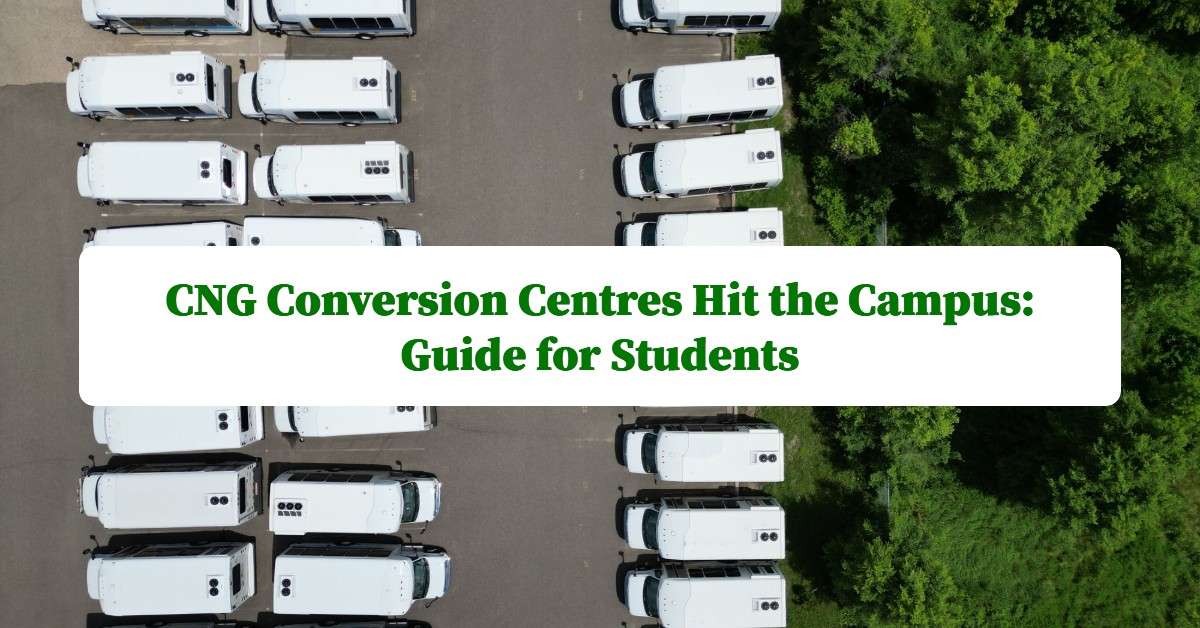
Between November 21 and November 23, 2026, Nigeria’s higher education sector reached a major clean-energy milestone. The Federal Government and the Midstream and Downstream Gas Infrastructure Fund (MDGIF) officially commissioned new Compressed Natural Gas (CNG) refuelling stations and CNG conversion centres across four South-West federal universities. Specifically, the commissioning covered the University of Lagos (UNILAG), the University of Ibadan (UI), the Federal University of Technology, Akure (FUTA), and the Federal University Oye-Ekiti (FUOYE) under Project SPROUT.
Most campus news blogs treat this development as a simple 250-word story about cheaper shuttle bus fares. However, stopping at transport fares misses the biggest career opportunity sitting right inside your university gate. Alongside cheaper rides to lecture halls, these CNG conversion centres serve as live industrial workshops for undergraduate training. Therefore, this comprehensive guide maps out the national expansion, breaks down the vehicle conversion technology in plain English, and shows engineering students how to turn these hubs into high-value SIWES placements and clean-energy certifications.
The Project SPROUT Rollout: Mapping the New Campus CNG Conversion Centres
The Ministry of Education, MDGIF, and private-sector partner FEMADEC Energy Limited jointly executed this campus gas rollout. During the inauguration ceremony, Education Minister Dr. Tunji Alausa emphasized that transport costs currently eat a massive portion of student upkeep allowances. Consequently, bringing refuelling infrastructure and CNG conversion centres directly onto university campuses tackles student living expenses at the source.
Inside the 11 Operational Campuses and the Target of 60 Institutions
The newly commissioned hubs at UNILAG, UI, FUTA, and FUOYE represent the third wave of a disciplined national expansion. According to MDGIF Executive Director Oluwole Adama and FEMADEC Energy CEO Fola Akinnola, this latest launch brings the cumulative footprint to 11 active federal universities nationwide.
First, the initiative began with three pioneering campus hubs at Yakubu Gowon University (University of Abuja), Obafemi Awolowo University (OAU), and the Federal University of Technology, Owerri (FUTO). Next, technical teams commissioned four additional stations across the South-South and South-East corridors just days before the South-West launch. Those facilities serve the University of Uyo (UNIUYO), the University of Calabar (UNICAL), the Federal University of Petroleum Resources, Effurun (FUPRE), and the University of Nigeria, Enugu Campus (UNEC).
Meanwhile, engineering crews are currently finalizing six additional university stations before the end of 2026. Three more campuses will come online early in 2027 to complete the Phase 1 target of 20 federal universities. Furthermore, Dr. Alausa confirmed that the Federal Government will extend the programme to another 40 tertiary institutions in the next phase. Ultimately, Project SPROUT will establish clean-energy mobility infrastructure across 60 federal and state campuses nationwide.
At UNILAG specifically, the rollout came with extra infrastructure commitments. The Education Minister announced that the university will receive 10 brand-new CNG-powered buses to boost internal campus mobility. Additionally, UNILAG will benefit from a proposed 12-megawatt solar mini-grid project to stabilize electricity across faculties and hostels.
The Parallel Federal Pledge: 50,000 Hostel Bed Spaces by Late 2027
Campus commuting costs do not exist in isolation. In fact, thousands of Nigerian undergraduates pay heavy daily transport fares simply because their schools lack enough on-campus hostel rooms. Recognizing this link, President Bola Tinubu and Dr. Tunji Alausa paired the CNG launch with a massive housing commitment.
Specifically, the Federal Government pledged to deliver more than 50,000 new hostel bed spaces across tertiary institutions by the end of 2027. The Tertiary Education Trust Fund (TETFund) and private-sector partners are driving this rollout through a N400 billion Student Hostels Programme. For example, UNILAG is slated to receive 1,700 additional bed spaces at its Akoka main campus alongside 350 beds at its College of Medicine.
Similarly, officials commissioned the newly donated 192-bed medical and dental hostel block at the University of Ibadan College of Medicine during the exact same November weekend. That modern 48-room facility includes private showers, kitchenettes, and four spacious reading rooms to close an acute clinical housing deficit. When more students live safely inside campus walls and ride low-cost gas shuttles, daily financial pressure drops significantly.
How Campus CNG Conversion Centres Transform Petrol Shuttle Buses
Many students see the green-and-white gas cylinders inside modern campus buses and immediately worry about engine damage or fire hazards. However, understanding the engineering behind the process replaces fear with technical appreciation. Modern CNG conversion centres do not destroy a vehicle’s original petrol engine. Instead, certified technicians install a parallel bi-fuel system that lets the driver switch smoothly between petrol and natural gas.
Plain-English Guide to How CNG Conversion Centres Retrofit Buses
Converting a standard petrol campus shuttle bus, minivan, or commercial sedan typically takes between four and six hours at accredited CNG conversion centres. Technicians follow a strict, standardized installation sequence to guarantee performance and safety:
- High-Pressure Cylinder Mounting: First, technicians fabricate heavy-duty steel brackets and bolt an ISO 11439 certified gas cylinder securely into the trunk or beneath the bus chassis. These seamless cylinders safely hold compressed natural gas at roughly 200 bar of pressure.
- High-Pressure Fuel Line Routing: Next, installers run rigid stainless-steel or specialized thermoplastic gas lines from the storage cylinder up to the engine bay. They route these pipes carefully away from hot exhaust manifolds and moving suspension parts.
- Pressure Regulation: Natural gas leaves the tank at extreme pressure, which an ordinary engine cannot handle directly. Therefore, technicians mount a pressure regulator (also called a reducer) inside the engine compartment. This mechanical device steps the gas pressure down to a safe, steady operating level while using engine coolant to prevent the expanding gas from freezing.
- Gas Injector Rail Installation: Subsequently, the team installs a dedicated gas injector rail onto the engine’s intake manifold. This rail sprays precise pulses of natural gas directly into the combustion cylinders alongside incoming air.
- Electronic Control Unit (ECU) Integration: Modern sequential conversion kits include a dedicated mini-computer. Technicians splice a specialized wiring harness into the bus’s existing oxygen sensor, manifold pressure sensor, and fuel injectors. Consequently, the gas ECU reads the engine’s real-time load and calculates exact fuel delivery automatically.
- Dashboard Switch and Leak Testing: Finally, installers mount a small fuel-selector button with LED level indicators near the steering wheel. Before handing back the keys, technicians pressurize the entire system with nitrogen and run ultrasonic leak detectors to verify zero gas escape.
Because the vehicle becomes a bi-fuel machine, the engine usually starts on petrol for a few seconds to warm up. Afterward, the ECU switches seamlessly to compressed natural gas without the driver lifting a foot off the pedal. If the gas tank runs dry mid-route, the bus flips automatically back to petrol with zero stalling.
The Economics Behind Lower Campus Shuttle Fares
The math behind CNG adoption explains why commercial drivers and university transport unions are rushing to convert their fleets. Across Nigeria in late 2026, retail petrol (PMS) hovers between N1,355 and N1,400 per litre at most filling stations. In contrast, Compressed Natural Gas retails between N380 and N450 per standard cubic metre (SCM), depending on the station and vehicle class.
Although petrol and CNG use different units of measurement, one standard cubic metre of CNG delivers roughly the same driving energy as one litre of petrol. Consequently, switching a high-mileage campus shuttle from petrol to gas slashes daily fuel expenses by 50 to 70 percent. Consider a realistic comparison for a busy campus shuttle bus running continuous loops between a university gate and main lecture theatres:
| Operating Metric | Petrol Shuttle Bus | Converted CNG Shuttle Bus |
| Average Fuel Rate (Late 2026) | N1,355 to N1,400 per litre | N380 to N450 per SCM |
| Estimated Daily Fuel Spend | N27,000 to N30,000 | N8,500 to N11,000 |
| Estimated Monthly Fuel Spend (24 Days) | N648,000 to N720,000 | N204,000 to N264,000 |
| Average Monthly Fuel Savings | Baseline | N440,000+ Saved Monthly |
| Engine Oil and Carbon Buildup | Higher carbon deposits | Cleaner burn, longer oil life |
Furthermore, natural gas burns much cleaner than liquid petrol because it enters the cylinder already in gaseous form. As a result, it does not wash lubricating oil off cylinder walls or leave heavy carbon sludge inside the engine. Therefore, converted shuttle buses require fewer oil changes and experience lower long-term maintenance bills. With refuelling stations sitting directly inside UNILAG, UI, FUTA, FUOYE, and seven other campuses, drivers no longer waste fuel driving across town to search for gas. Dr. Alausa rightly urged university authorities and transport operators to ensure these massive savings translate directly into affordable student fares.
Turning CNG Conversion Centres into Living Laboratories for SIWES
While lower shuttle fares help every student’s wallet, engineering undergraduates hold the winning ticket in this rollout. During the commissioning, FEMADEC CEO Fola Akinnola explicitly described every Project SPROUT station as a “living laboratory and hands-on training and conversion hub.” Rather than merely selling fuel, these CNG conversion centres exist to train the next generation of Nigerian energy professionals in vehicle conversion, gas infrastructure management, and international safety protocols.
Why Traditional Engineering Practicals Fall Short
Every engineering undergraduate in Nigeria knows the quiet frustration of campus laboratory courses. Too often, students memorize thermodynamic cycles and control theory from worn textbooks while standing next to broken, decades-old workshop machines. When 400-level arrives, thousands of students scramble desperately for six-month Student Industrial Work Experience Scheme (SIWES) slots. Unfortunately, many settle for irrelevant administrative offices or roadside workshops that teach zero modern industry standards.
Having commercial-grade CNG conversion centres operating ten minutes from your engineering faculty changes that equation completely. Suddenly, high-pressure gas compression, electronic engine calibration, and international ISO safety protocols are happening live on campus every single weekday.
Discipline-by-Discipline Opportunities at Campus CNG Conversion Centres
Almost every major engineering department connects directly to the daily operations inside these CNG conversion centres. Instead of waiting for graduation, students across four core fields can map their coursework directly onto real workshop tasks:
- Mechanical and Automotive Engineering Students: You can gain direct workshop mastery in structural bracket fabrication, mechanical stress analysis, manifold drilling, and engine tuning. Furthermore, observing how high-pressure reducers handle gas expansion brings your applied thermodynamics lectures to life immediately.
- Petroleum and Chemical Engineering Students: Natural gas is your core domain. Working at a campus refuelling and conversion hub exposes you to multi-stage gas compression physics, standard cubic metre (SCM) metering accuracy, moisture filtration, and compressor station maintenance. Moreover, you practice live Health, Safety, and Environment (HSE) protocols, including burst-disc safety valves, emergency shut-off systems, and high-pressure leak audits.
- Electrical, Electronics, and Mechatronics Engineering Students: Modern sequential CNG conversion is heavily software-driven. You can learn automotive wiring harness routing, injector emulation, oxygen and MAP sensor interfacing, and live computer diagnostics. Specifically, connecting a laptop to a gas ECU to tune short-term and long-term fuel trims (STFT and LTFT) gives you elite automotive mechatronics skills.
- Industrial and Production Engineering Students: You can study workshop bay turnaround optimization, spare-part inventory tracking, preventive maintenance scheduling, and safety compliance auditing inside a busy commercial facility.
Building a Clean-Energy Career from Campus CNG Conversion Centres
Nigeria’s clean-energy transport sector is no longer a pilot experiment. According to data from the Presidential Initiative on Compressed Natural Gas and Electric Vehicles (Pi-CNG & EV), the country has already crossed 140,000 vehicle conversions, over 400 certified conversion workshops, more than 100 refuelling stations, and over 8,000 trained technicians. Billions of dollars in private and public capital are pouring into gas mobility. Consequently, qualified engineers who understand both vehicle conversion and gas dispensing infrastructure enjoy massive job demand right now.
Securing Early SIWES Placements at CNG Conversion Centres
Do not wait until your faculty posts the official SIWES notice to take action. Start positioning yourself right now if you attend UNILAG, UI, FUTA, FUOYE, UNIUYO, UNICAL, FUPRE, UNEC, OAU, FUTO, or UNIABUJA.
First, visit the operational CNG conversion centres on your campus during your free lecture periods. Introduce yourself professionally to the site engineer or hub supervisor, and ask about structured student industrial attachment windows or weekend observation cohorts. Next, approach your departmental SIWES coordinator and Faculty Dean to confirm whether the university has signed a formal student placement memo with FEMADEC Energy or MDGIF.
Additionally, investigate official national accreditation pathways while you train. In Nigeria, the National Automotive Design and Development Council (NADDC), the Standards Organisation of Nigeria (SON), and the National Board for Technical Education (NBTE) oversee technician certification. Completing hands-on hours on campus prepares you to earn recognized National Skills Qualification (NSQ) credentials in CNG conversion, such as those structured by the Nigerian Institute of Transport Technology (NITT) and NADDC-aligned training centres.
Monetizing Clean-Energy Skills Before Graduation
Graduating with a Bachelor of Engineering degree alongside verifiable CNG conversion and gas safety experience separates you instantly from tens of thousands of generic job seekers. Better yet, you do not have to wait for NYSC mobilization to earn from these technical skills.
As campus shuttle unions, staff cooperatives, and logistics fleets around your university convert their vehicles, ongoing maintenance demand surges. Every converted bus requires periodic gas filter replacements, ECU re-calibration, pressure-line inspections, and sensor troubleshooting. By apprenticing inside your campus workshop during 300-level and 400-level, you build the competence to assist certified technicians on weekend service jobs.
Furthermore, document every project you observe and execute (while respecting site safety and photography rules). Write clear technical breakdowns of gas compression safety or ECU calibration for your LinkedIn profile and student portfolio. When major energy firms, gas distribution startups, or fleet operators advertise graduate engineering roles in 2027, your resume will showcase real, field-tested clean-energy execution rather than empty classroom theory.
Stepping Into Nigeria’s Clean-Energy Workforce Today
The November 2026 commissioning of CNG stations at UNILAG, UI, FUTA, and FUOYE marks far more than a routine government ceremony. Paired with the expansion plan toward 60 tertiary institutions and the pledge for 50,000 new hostel bed spaces by late 2027, Project SPROUT directly tackles two of the toughest hurdles facing Nigerian students: transport costs and accommodation stress.
Most importantly, this nationwide gas infrastructure places a thriving industrial sector right inside university gates. While ordinary commuters celebrate lower shuttle fares, forward-thinking engineering and technical students should see an open training laboratory. Walk over to your campus conversion hub this week, speak with the engineers on duty, and start building the clean-energy credentials that will define Nigeria’s transport industry for the next decade.
Does your university already have an active CNG station under Project SPROUT, or are you waiting for the next phase of the 60-campus rollout? If you are an engineering student, would you choose an on-campus CNG conversion hub for your upcoming SIWES placement? Drop your university name, department, and thoughts in the comments section below!
Recommended:
Leveraging Campus Competitions for Tech Funding and Networking
Beyond the Counter: Inside UBA’s New Innovation Hub at UNILAG
Young talented Nigerian students BUILD A MINI SPORTS car on campus
Free Campus Wi-Fi Could Cost You: How to Protect Your Data on Open Networks
Top Tech Innovations From Nigerian Universities in 2026/2027
Related posts:
Top 10 Coding Bootcamps for University Students Worldwide

How Students Are Making Money Through Tech in Nigeria

Samsung Galaxy S26 Ultra, The Really New Technology In Display

AI Replicates The Voices Of Victims Of School Shootings To Call Out Politicians

Secondary School Students Are Getting A.I Tools To Tackle Complex Tasks