
The volume of academic research published daily makes a comprehensive literature review increasingly challenging for students and researchers. AI research paper assistants now offer powerful solutions to help you skim, analyze, and synthesize research papers more effectively than traditional methods allow.

These intelligent tools leverage machine learning and natural language processing to extract key information, highlight critical citations, and identify patterns across multiple studies simultaneously. Understanding how to implement AI research paper assistants into your workflow dramatically reduces time spent on literature review while improving the quality of synthesis.
This guide explores ten cutting-edge AI tools transforming how modern researchers engage with academic literature.
Top 10 AI Research Paper Assistants
1. Semantic Scholar: Intelligent Summarization and Citation Analysis
Semantic Scholar represents one of the most powerful AI research paper assistants available, providing “TLDR” (Too Long; Didn’t Read) summaries for millions of papers. Developed by the Allen Institute for AI, this platform uses sophisticated algorithms to identify the most important sentences and concepts within research papers.

The tool maintains a massive, verified database of academic literature indexed from major publishers and repositories. When you search for papers on Semantic Scholar, the platform displays abbreviated summaries highlighting the most influential findings and key takeaways. This functionality lets you quickly filter which studies warrant full-text reading.
Furthermore, Semantic Scholar helps you understand citation relationships and research influence. The platform identifies the most cited papers in your research area and provides context on how subsequent researchers have built on foundational work. This capability makes Semantic Scholar indispensable for understanding your field’s intellectual landscape.
The interface proves remarkably user-friendly for researchers beginning their literature review. You can search by topic, author, or keyword, then immediately access TLDR summaries without navigating to external databases. Additionally, you can create personalized research feeds that track specific topics or authors, ensuring you stay current with emerging research.
2. Scite: Context-Aware Citation Intelligence
Scite operates as a specialized platform that fundamentally changes how researchers understand citations. Unlike traditional citation counting, Scite uses “Smart Citations” to show the exact context of how papers have been cited in subsequent research. This AI research paper assistant technology reveals whether researchers have supported, disputed, or simply mentioned original findings.

This distinction proves critical for evaluating research credibility. A frequently cited paper might initially appear influential, but Scite reveals if those citations predominantly contradict the original findings. Conversely, papers with fewer citations might contain highly cited supporting evidence for their claims.
The platform analyzes millions of full-text articles to extract citation context. When you view a paper on Scite, you see a detailed breakdown of how other researchers cited it. Additionally, the tool displays which papers cite your target research and whether they agree or disagree with its conclusions. This information dramatically accelerates your understanding of how specific findings fit within broader scientific consensus.
Scite also provides specialized features for thesis writers. You can track how your research area’s foundational papers have been cited over time, revealing how scientific understanding has evolved. Furthermore, the platform alerts you to recent papers citing seminal works in your field, helping you identify newly published research relevant to your focus.
3. Elicit: Automated Data Extraction and Comparison
Elicit functions as an AI research paper assistant designed specifically for evidence extraction and comparison. This tool works differently from traditional search engines by automatically finding relevant papers and extracting crucial data into structured tables.

When you input a research question into Elicit, the platform searches academic databases and identifies papers addressing your query. Subsequently, it extracts methodology details, participant demographics, key findings, and effect sizes directly from papers. The tool then organizes this information into comparison tables, dramatically accelerating your ability to synthesize multiple studies simultaneously.
This functionality proves particularly valuable for meta-analyses and systematic reviews. Instead of manually reading dozens of papers and recording findings in spreadsheets, Elicit automates much of this process. The AI accurately extracts participant counts, sample characteristics, and measured outcomes, reducing human error and saving countless hours.
Elicit also identifies papers that directly contradict each other or reveal knowledge gaps within your research area. By comparing findings across multiple studies, you quickly understand which conclusions appear robust across samples and which findings seem study-specific. This analytical capability strengthens your ability to develop nuanced thesis arguments.
Read: 10 Free AI Education Platforms from Tech Giants Worth Thousands in Value
4. NotebookLM: Personalized AI Collaboration Within Your Documents
NotebookLM represents a revolutionary approach to AI research paper assistants, functioning as a personalized AI collaborator for your uploaded research collection. This tool lets you upload entire folders of PDFs to create a private knowledge base.

The platform remains strictly “grounded” in your uploaded sources, meaning it only references papers you’ve provided. This grounding prevents the hallucinations sometimes plaguing general AI assistants while ensuring complete accuracy in citations. Subsequently, you can ask questions across dozens of papers simultaneously, discovering themes, contradictions, and synthesized insights.
For instance, you might ask NotebookLM, “How do these papers differ in their definitions of cognitive load?” The assistant analyzes all uploaded papers and provides detailed comparisons, citing specific sources. This capability enables a sophisticated synthesis impossible through manual reading alone.
NotebookLM also generates customized study guides and flashcard sets from your document collection. These tools help consolidate learning and reveal gaps in your understanding. Furthermore, you can request the AI to generate discussion questions or identify conflicting methodologies across papers.
5. SciSpace: Real-Time Explanation During Reading
SciSpace functions as a comprehensive reading platform featuring an AI “Copilot” that provides instant assistance while you engage with research papers. This tool addresses one of the literature review’s fundamental frustrations: encountering complex terminology, equations, or concepts requiring external research.
While reading papers on SciSpace, you can highlight challenging text, mathematical equations, or data tables. The AI assistant immediately provides explanations in accessible language or answers specific questions about highlighted content. This real-time support dramatically accelerates reading speed while improving comprehension.
The platform particularly excels at technical papers that contain complex mathematics or specialized notation. Rather than pausing your reading to search for equation explanations, you simply highlight the problematic section and receive instant clarification. This functionality proves invaluable for researchers working across disciplines or engaging with unfamiliar methodological approaches.
SciSpace also provides full-paper summaries and generates structured outlines of paper arguments. These tools help you quickly identify whether specific papers merit complete reading or whether abstracts and summaries suffice for your purposes. Additionally, the platform allows you to annotate and take notes directly within its interface, streamlining your research workflow.
6. Scholarcy: Automated Flashcard Generation from Research Papers
Scholarcy is a specialized AI research paper assistant that converts lengthy research papers into structured summaries, or “flashcards.” This platform automatically extracts key findings, methodology, limitations, and conclusions, presenting them in digestible formats.

For thesis writers building literature review backgrounds, Scholarcy dramatically accelerates the process. The tool identifies and extracts the research questions addressed, the sample sizes, the key variables measured, and the primary findings. Rather than manually summarizing dozens of papers, you receive professionally organized flashcards requiring minimal revision.
The platform proves particularly useful for building comprehensive literature review sections. You can generate flashcards for dozens of papers, then organize them by theme, methodology, or finding type. This organization naturally supports the synthesis required for effective literature review writing.
Scholarcy also automatically identifies paper limitations, helping you understand the methodological constraints that affect research validity. This information strengthens your ability to contextualize findings and acknowledge limitations in your own research. Additionally, the tool flags contradictory findings across papers, highlighting areas where scientific consensus remains incomplete.
7. Consensus: Scientific Opinion Synthesis Engine
Consensus represents a distinctive AI research paper assistant search engine specifically designed to extract answers directly from peer-reviewed research. Rather than returning lists of papers, Consensus analyzes thousands of studies to provide direct answers to your research questions.

When you pose a question to Consensus, the platform searches relevant papers and synthesizes their findings. Subsequently, it provides a “Consensus Meter” showing the prevailing scientific opinion on your topic. Green indicates strong consensus among papers, while red signals disagreement or limited research.
This functionality proves invaluable when you need to understand the current scientific consensus on specific topics. Instead of manually reading hundreds of papers to determine whether researchers generally support a particular hypothesis, Consensus provides instant evidence-based answers. Furthermore, the platform identifies which papers support the prevailing consensus and which contradict it.
Consensus also helps identify research gaps. When there is little consensus on a topic, the platform indicates that scientists remain divided or that limited research addresses your question. This insight helps you position your own research within the broader knowledge landscape.
Read: The Complete Guide to Access Academic Articles and Scholarly Publications for Your Thesis
8. Mathpix: Technical Content Conversion and Accessibility
Mathpix is the industry standard for handling technical documents that include complex equations, chemical diagrams, or specialized data tables. This AI research paper assistant tool addresses a fundamental challenge: converting visual representations of technical content into editable, usable formats.
When you encounter complex mathematical equations in PDFs, Mathpix lets you photograph or screenshot them. The platform instantly converts the image into editable LaTeX, Word, or Excel formats. This functionality proves invaluable when you need to incorporate equations into your thesis, build spreadsheets with extracted data, or reference complex formulas in your writing.
The platform also excels with chemical structure diagrams and specialized scientific notation. Rather than manually recreating complex diagrams, you simply upload images and receive editable versions. This capability saves researchers enormous time while ensuring accurate technical reproduction.
Mathpix integrates seamlessly with academic writing platforms and spreadsheet software. You can export converted content directly to your thesis document or research spreadsheet, streamlining your workflow. Additionally, the tool maintains high accuracy rates even with complex mathematical notation, producing publication-quality output.
9. ChatPDF and Humata AI: Interactive Document Dialogue
ChatPDF and Humata AI function as interactive chatbots for your research documents. These AI research paper assistants allow you to upload specific PDFs and engage in conversation to extract information efficiently.
With these tools, you can ask questions in your uploaded PDF and receive specific answers with page citations. For instance, you might ask, “What were the sample characteristics?” and receive direct answers with references. This conversational interface proves more intuitive than traditional search functions for many researchers.
Both platforms excel at rapid document summarization. Rather than reading entire papers, you can request executive summaries, methodology overviews, or specific findings. The tools extract relevant information and present it concisely, allowing you to determine quickly whether papers merit full reading.
Furthermore, you can ask these AI research paper assistants to identify contradictions within papers or clarify confusing sections. The conversational nature makes these tools particularly accessible for researchers uncomfortable with technical interfaces. Additionally, you can upload multiple related PDFs and compare findings across documents through natural language queries.
10. Paper Digest: High-Speed Literature Skimming
Paper Digest specializes as a skimming tool, providing concise three-sentence summaries of research papers. This AI research paper assistant platform targets researchers conducting high-speed literature searches requiring rapid relevance assessment.
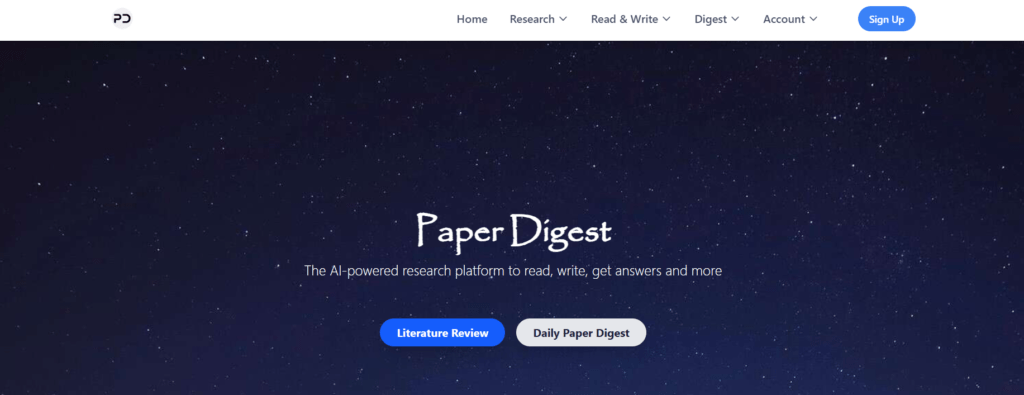
The tool distills a paper’s core findings into three essential sentences, helping you determine whether a paper warrants further investigation. This functionality proves invaluable when reviewing hundreds of potentially relevant papers. Instead of reading abstracts or opening full PDFs, you instantly receive essential information.
Paper Digest integrates with major academic databases, allowing you to access summaries directly from search results. This integration streamlines your workflow, preventing context switching between search platforms and summarization tools. Additionally, the platform maintains high accuracy in capturing the primary contributions of papers.
The tool is particularly useful for literature-mapping projects that require a comprehensive review of large paper collections. By rapidly assessing relevance through three-sentence summaries, you can efficiently categorize papers by themes, methodologies, or relevance to your research questions.
Maximizing Efficiency Through AI Research Paper Assistants Integration
Successfully implementing these AI research paper assistants requires strategic workflow design. Rather than using each tool independently, consider integrating them throughout your literature review process.
Begin with Semantic Scholar or Consensus to identify foundational papers and understand prevailing consensus. Subsequently, use Paper Digest for rapid relevance screening across large paper collections. For papers that require detailed analysis, use NotebookLM or Elicit to extract and compare specific data points.
When working with technical papers, activate SciSpace’s explanation features to accelerate comprehension. Use Scholarcy to generate flashcards for papers you’ll reference frequently. Finally, use Mathpix for any technical content you plan to incorporate into your thesis.
This integrated approach transforms the literature review from a time-consuming, linear process into an efficient, multi-layered analytical workflow. You dramatically reduce time spent on reading while improving synthesis quality through AI-assisted analysis.
Conclusion
AI research paper assistants fundamentally transform how modern researchers engage with academic literature. These ten tools—from Semantic Scholar’s summarization to Mathpix’s technical conversion—address specific challenges within the literature review process.
By strategically implementing AI research paper assistants into your workflow, you reduce time spent on routine analysis while improving your ability to identify patterns, synthesize findings, and develop nuanced arguments.
Whether you’re conducting systematic reviews, building literature backgrounds, or exploring new research areas, these tools accelerate your productivity while maintaining rigorous analytical standards.
Start with one or two tools matching your immediate needs, then gradually integrate additional AI research paper assistants as your comfort level increases. Your thesis quality and timeline will both benefit from this technology-enhanced research approach.