
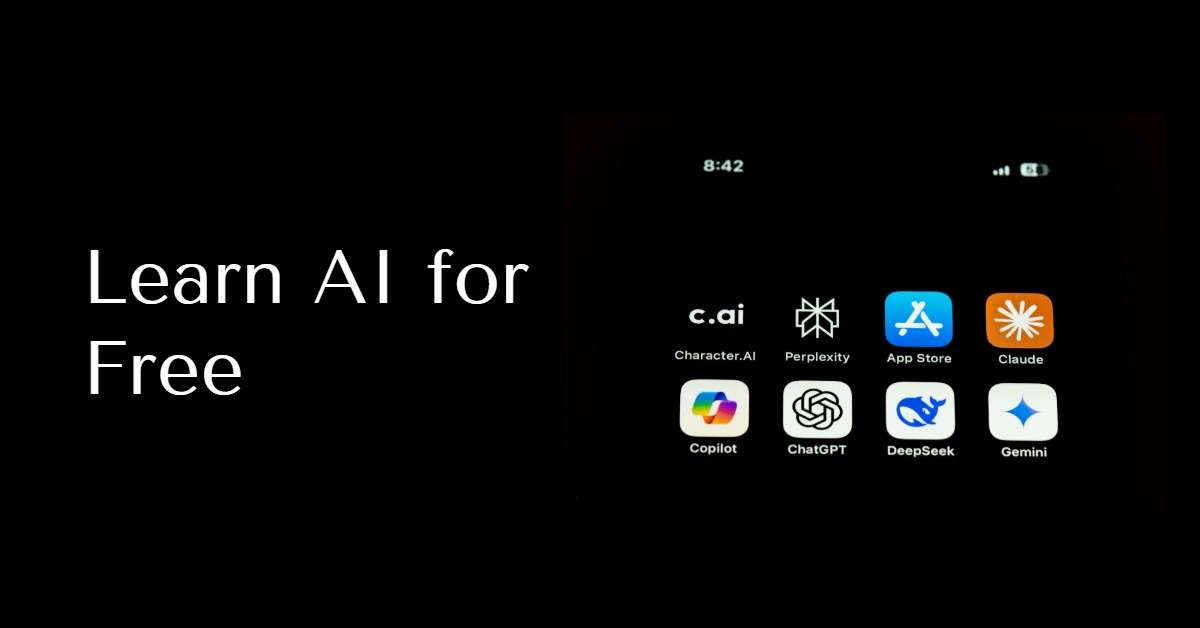
Hello and welcome. Here are 10 free AI education platforms where you can learn a university-grade curriculum at zero cost.

The artificial intelligence revolution isn’t just changing how we work—it’s transforming how we learn. Major tech companies have recognized something crucial: widespread AI literacy benefits everyone. Consequently, they’re investing millions in free educational platforms that rival the cost of expensive university programs.
You don’t need a computer science degree or a five-figure course budget anymore. Instead, you can learn directly from the companies building the technology. These aren’t watered-down marketing materials either. They’re comprehensive, hands-on curricula designed to create skilled practitioners.
This guide explores ten premium AI education platforms that cost absolutely nothing. Furthermore, each platform offers unique strengths depending on your goals and technical background.
10 Free AI Education Platforms from Tech Giants
1. Anthropic: Building Safe AI with Claude
Platform: anthropic.skilljar.com
One of the best free AI education platforms, Anthropic, has positioned itself as the safety-first AI company. Their educational platform fully reflects this philosophy. You’ll learn not just how to use Claude, but how to implement constitutional AI principles in your applications.
The curriculum covers prompt engineering techniques specific to Claude’s unique architecture. Additionally, you’ll explore concepts like harmlessness, helpfulness, and honesty—the three pillars of Anthropic’s approach. Their courses include practical exercises on steering AI behavior without compromising capability.
Best for: Developers building customer-facing AI applications where safety and reliability matter most. Product managers working on AI features will also find tremendous value here.
The platform includes real-world case studies from companies using Claude in production. Moreover, you’ll gain access to best practices for reducing hallucinations and improving response consistency.
2. Google: AI for Everyone
Platform: grow.google/ai
Google democratizes AI education better than perhaps any other company. Their flagship “AI Essentials” course requires zero technical background. Instead, it focuses on practical productivity gains anyone can achieve immediately.
The curriculum teaches you how to leverage AI tools for writing, analysis, and decision-making. You’ll learn prompt crafting techniques that work across platforms. Furthermore, Google includes modules on responsible AI use and ethical considerations.
What sets this apart is the non-technical approach. Google understands that AI literacy matters for marketers, HR professionals, and managers—not just engineers. Therefore, they’ve crafted content that translates technical concepts into business value.
Best for: Professionals in non-technical roles who want to leverage AI tools effectively. Business leaders planning AI integration will find the strategic perspective invaluable.
The courses include downloadable templates, prompt libraries, and implementation checklists. Additionally, Google offers certification upon completion, adding credential value to your professional profile.
3. Meta: Open-Source AI Mastery
Platform: ai.meta.com/resources
Meta has bet heavily on open-source AI with their Llama model family. Their educational resources reflect this commitment to openness and accessibility. You’ll find comprehensive documentation, tutorials, and research papers all freely available.
The platform excels at teaching developers how to work with open-source models. You’ll learn fine-tuning techniques, deployment strategies, and optimization methods. Moreover, Meta provides detailed comparisons between different model sizes and their use cases.
Their resources include Jupyter notebooks with working code examples. You can experiment with Llama models directly, gaining hands-on experience without infrastructure costs. Furthermore, Meta regularly updates content to reflect their latest model releases.
Best for: Developers interested in open-source AI and those wanting control over their AI infrastructure. Researchers exploring model customization will find extensive technical depth here.
Meta’s community forums add significant value, too. You’ll connect with other developers, troubleshoot issues, and discover creative implementations of Llama models.
4. NVIDIA: Hardware-Accelerated AI

Platform: developer.nvidia.com/training
NVIDIA builds the GPUs powering AI’s renaissance. Consequently, their educational platform focuses on optimization, acceleration, and infrastructure. You’ll dive deep into CUDA programming, parallel processing, and GPU-accelerated computing.
The curriculum includes specialized tracks for different AI applications. Computer vision, natural language processing, and generative AI each get dedicated learning paths. Additionally, NVIDIA teaches you how to maximize hardware efficiency—crucial knowledge as compute costs rise.
Their Deep Learning Institute offers hands-on labs with actual GPU access. You’ll write code, train models, and measure performance improvements in real-time. Moreover, the courses cover both cloud and edge deployment scenarios.
Best for: Machine learning engineers focused on performance optimization. DevOps professionals managing AI infrastructure will gain critical insights into hardware utilization.
NVIDIA also provides industry-specific content for healthcare, autonomous vehicles, and robotics. Therefore, you can align your learning with specific application domains.
5. Microsoft: Enterprise AI at Scale

Platform: learn.microsoft.com/training
Microsoft’s learning platform spans its entire ecosystem, but its AI content deserves special attention. You’ll master Azure AI services, Copilot integration, and enterprise deployment patterns. Furthermore, Microsoft emphasizes governance, security, and compliance—critical for business adoption.
The curriculum covers both low-code and pro-code approaches. Business users can learn to customize Copilot without writing code. Meanwhile, developers can dive into Azure Machine Learning, Azure OpenAI Service, and custom model deployment.
Microsoft includes extensive modules on responsible AI frameworks. You’ll learn how to audit models, ensure fairness, and maintain transparency. Additionally, their courses address data privacy concerns specific to enterprise environments.
Best for: IT professionals in enterprise environments. Solution architects designing AI-powered business applications will find comprehensive architectural guidance.
The platform offers learning paths aligned with Microsoft certifications. Consequently, you can validate your skills with industry-recognized credentials that enhance career prospects.
6. OpenAI: From the Creators of ChatGPT
Platform: academy.openai.com
One of the best free AI Education platforms is academy.openai.com. OpenAI provides direct instruction on its groundbreaking models. You’ll learn API optimization, best practices for prompt engineering, and advanced features most users never discover. Furthermore, OpenAI regularly updates content to reflect its latest releases.
The curriculum emphasizes practical implementation. You’ll build applications using GPT-4, DALL-E, and Whisper. Moreover, OpenAI teaches you how to manage costs effectively—essential knowledge given API pricing structures.
Their documentation includes detailed examples across programming languages. Python, JavaScript, and curl examples accompany every concept. Additionally, OpenAI provides playground environments for experimentation without writing code.
Best for: Developers building applications on OpenAI’s platform. Product managers defining AI features will gain a crucial understanding of capabilities and limitations.
OpenAI’s cookbook repository on GitHub complements their educational content. You’ll find production-ready code examples that solve real business problems using their APIs.
7. IBM: Ethical AI and Data Science
Platform: skillsbuild.org
IBM brings decades of enterprise AI experience to its educational platform. Their approach emphasizes ethics, governance, and data science fundamentals. You’ll learn not just how to build AI, but how to build it responsibly.
The curriculum covers classical machine learning alongside modern deep learning. IBM teaches decision trees, random forests, and gradient boosting before diving into neural networks. Therefore, you’ll understand when simpler approaches outperform complex ones.
Their ethical AI modules address bias detection, fairness metrics, and explainability techniques. Additionally, IBM includes regulatory considerations, such as GDPR and industry-specific compliance requirements.
Best for: Data scientists seeking a comprehensive foundation in machine learning. Compliance officers and risk managers will appreciate the governance-focused content.
IBM offers mentorship programs connecting learners with industry professionals. Consequently, you gain not just knowledge but also networking opportunities and career guidance.
8. AWS: Cloud-Scale AI Deployment
Platform: skillbuilder.aws
Amazon Web Services dominates cloud computing, and its AI education reflects this leadership. You’ll master Amazon Bedrock, SageMaker, and the full suite of AWS AI services. Furthermore, AWS teaches you how to architect solutions that scale from prototype to production.
The curriculum emphasizes practical deployment challenges. You’ll learn about model hosting, endpoint management, and production monitoring. Moreover, AWS provides cost-optimization strategies crucial for sustainable AI operations.
Their hands-on labs provide temporary AWS environments for experimentation. You’ll deploy actual models without needing your own AWS account. Additionally, AWS offers skill-builder subscriptions with advanced content, though substantial free material is available.
Best for: Cloud engineers and solutions architects. Data scientists needing to productionize models will find invaluable deployment guidance.
AWS includes specialty tracks for computer vision, natural language processing, and forecasting. Therefore, you can focus on your specific application domain while learning cloud fundamentals.
9. DeepLearning.AI: Mathematical Foundations
Platform: deeplearning.ai
Andrew Ng, a pioneer in modern AI education, curates DeepLearning.AI. The platform offers perhaps the most rigorous mathematical foundations available for free. You’ll understand not just how to use AI, but how it actually works under the hood.
The curriculum starts with neural network fundamentals and progresses to cutting-edge architectures. You’ll learn backpropagation, optimization algorithms, and regularization techniques. Moreover, DeepLearning.AI emphasizes intuition alongside mathematics—making complex concepts accessible.
Their courses include programming assignments in TensorFlow and PyTorch. You’ll implement algorithms from scratch, cementing your understanding. Additionally, Ng’s teaching style breaks down intimidating concepts into digestible explanations.
Best for: Aspiring machine learning engineers who want a deep theoretical understanding. Researchers and academics will appreciate the rigorous approach.
DeepLearning.AI partners with companies such as OpenAI and AWS to offer specialized courses. Consequently, you’ll learn both foundations and cutting-edge applications from authoritative sources.
10. Hugging Face: The Open-Source Playground

Platform: huggingface.co/learn
Hugging Face has become the GitHub of AI—the default platform for sharing models and datasets. Their educational content teaches you how to leverage this ecosystem effectively. You’ll master Transformers, Diffusers, and other libraries powering modern AI.
The curriculum is intensely practical. You’ll fine-tune models, deploy applications, and share your work with the community. Furthermore, Hugging Face teaches you how to evaluate models, compare approaches, and select the right tool for your needs.
Their documentation includes thousands of model cards with implementation examples. You’ll see how others solved similar problems and adapt their approaches. Additionally, Hugging Face spaces let you deploy demos without infrastructure costs.
Best for: Developers wanting hands-on experience with state-of-the-art models. ML engineers focused on rapid prototyping and experimentation will thrive here.
The platform’s community aspect accelerates learning tremendously. You’ll discover new techniques, get feedback on your work, and contribute to open-source projects.
Choosing Your Learning Path
Each of these free AI education platforms offers unique strengths. Therefore, selecting the right one depends on your goals and background. Non-technical professionals should start with Google’s AI Essentials. Developers building specific applications should begin with the platform hosting their chosen models—OpenAI for GPT, Meta for Llama, Anthropic for Claude.
For comprehensive foundations, combine DeepLearning.AI’s theory with Hugging Face’s practical exercises. Enterprise professionals should prioritize Microsoft or AWS depending on their cloud environment. Those focused on responsible AI should explore IBM and Anthropic’s ethics-centered content.
The best approach is to sample multiple platforms. Consequently, you’ll develop a well-rounded understanding spanning theory, practice, and ethics.
Conclusion
The barrier to AI education has collapsed. These ten platforms offer genuinely valuable, university-grade curricula for free. Tech giants invest in this education because they benefit from a skilled ecosystem—but so do you.
Start with one platform aligned to your immediate needs. Complete a course, build a project, and share your work. Then, expand to complementary platforms that fill knowledge gaps. Moreover, revisit these resources regularly as companies update content with new developments.
The AI revolution rewards the prepared. These free platforms ensure preparation is available to everyone, regardless of budget or background. Your expertise determines your success—not your ability to pay for education.
Recommended:
Top 10 Coding Bootcamps for University Students Worldwide
Top 10 Best Free MIT Online Courses to Take in 2026
How Students Are Making Money Through Tech in Nigeria