
On March 9, 2026, the Federal Government opened recruitment for a new phase of what it describes as the largest youth economic empowerment programme in Nigeria’s history. The federal government announced that recruitment for Batch B beneficiaries of the Youth Economic Intervention and De-Radicalisation Programme (YEIDEP) commenced nationwide on Monday, March 9, 2026. The announcement was made in a statement by the programme’s Coordinator-General, Kennedy Iyere, who urged eligible Nigerians between the ages of 18 and 50 to participate in the exercise.
The numbers behind the programme are ambitious. YEIDEP aims to empower up to 20 million youths with startup capital and support mechanisms designed to stimulate economic participation and reduce social and security risks associated with youth unemployment.
That is the promise. But the reality, as of March 2026, is far more complicated. This guide covers everything — the programme’s structure, how to register, who qualifies, which banks are involved, what the grant actually offers, and critically, the concerns you should understand before committing your time, your NIN, and your expectations.
What is YEIDEP?
First, the basics. The Youth Economic Intervention and De-Radicalization Programme (YEIDEP) is a pro-youth economic self-emancipation empowerment initiative whose aim is to facilitate and provide adequate economic engagement of youths for active economic participation, nation-building, economic development, de-radicalization and national security.
YEIDEP is a youth-focused strategic socio-economic emancipation empowerment intervention launched and anchored by Youths Off The Street Initiative (YOTSI) through the Federal Ministry of Youth Development, in collaboration with the Nigerian Senate (10th Assembly), through its Committee on Sports Development.
In plain language, YEIDEP is a government-backed scheme that intends to give Nigerian youths business grants and entrepreneurial support.
Its mission is to mitigate youth unemployment, grow Nigeria’s economy and alleviate household poverty by helping youths to access the business financing, enterprise development services and other basic economic incentives and empowerment platforms needed to transform themselves into entrepreneurs, job creators, income earners and builders of wealth.
The programme was formed out of a clear problem. YEIDEP was formed out of the existing need to squarely address Nigeria’s overwhelming problems of high youth unemployment, youth economic underutilization, youth poverty and their consequences of low economic development, household poverty, radicalization and insecurity.
What the Programme Offers
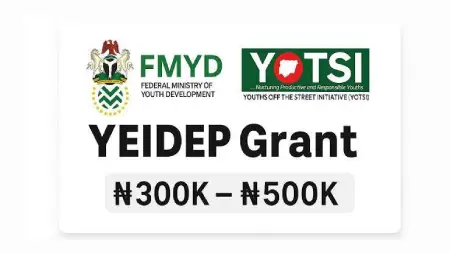
According to programme organisers and verified reports, here is what YEIDEP promises: Business grants ranging from ₦50,000 to ₦500,000 for eligible youth entrepreneurs. In addition, the programme promises access to enterprise development services, financial training, and mentorship, as well as opportunities for economic self-reliance and business growth, and a contribution to poverty alleviation and national security through de-radicalization and youth empowerment.
The financial support, according to the Minister of Youth Development, is structured as grants, not loans. The financial support to beneficiaries would be provided as grants rather than loans, with a minimum of N500,000 earmarked as start-up capital for each participant. The initiative runs in multiple batches over two years, with ongoing phases of registration, selection, and disbursement.
The targeted sectors are also broad. Applicants should have an interest in or be involved in sectors such as agriculture, fashion, technology and ICT, entertainment, sports, renewable energy, and other productive business areas.
Who Qualifies for YEIDEP?
The eligibility criteria are straightforward. The Coordinator-General urged eligible Nigerians between the ages of 18 and 50 to participate in the exercise.
Here is a summary of the documented requirements:
- Age: 18 to 50 years old
- Nationality: Nigerian citizen
- Identification: Valid NIN (National Identification Number) and BVN (Bank Verification Number) are required
- Education: No degree is required. You do not need to have a degree. Whether you’re a graduate, skilled worker, or just someone with a good business idea, YEIDEP is open to you.
- Location: Applicants from any state can register
- Business interest: Applicants should have an interest in productive sectors
One important restriction applies to repeat applicants. Individuals who successfully registered under Batch A and already possess confirmed YEIDEP bank accounts are not eligible for the new recruitment phase. However, those who registered during Batch A but did not receive confirmed accounts are encouraged to participate in Batch B.
How Batch B Registration Works (The Key Difference)
This is the most important change between Batch A and Batch B. If you registered during Batch A, the process was entirely online. Batch B is different. Unlike the Batch A recruitment phase, which relied on an online registration portal for data capture and bank account processing, Batch B applicants are required to visit designated partner banks physically to open a YEIDEP bank account as part of the registration process. The programme organisers stated that opening the YEIDEP bank account remains the only valid means of becoming a recognised participant and potential beneficiary, stressing that the registration process is free of charge.
That last part cannot be overstated. Applicants were advised to report any request for payment by bank officials or intermediaries.
Here is the step-by-step process:
Step 1: Gather Your Documents
Before visiting any bank, make sure you have the following:
- Valid National Identification Number (NIN)
- Bank Verification Number (BVN)
- A valid form of identification (National ID card, voter’s card, or international passport)
- Your phone number
- Knowledge of the business or sector you are interested in
Step 2: Visit an Authorised Partner Bank
Walk into any branch of the following authorised banks. Authorised banks for the exercise include Fidelity Bank, Keystone Bank, Alpha Morgan Bank, Wema Bank, Union Bank, Guaranty Trust Bank, Zenith Bank, Access Bank, United Bank for Africa, Ecobank and Lotus Bank.
Step 3: Request to Open a YEIDEP Bank Account
Tell the bank you are there to register for the YEIDEP programme. Programme organisers explained that opening this account is the only recognised pathway for participation and potential selection as a beneficiary.
Step 4: Complete Your Registration at the Bank
Provide your personal details, NIN, and BVN. The bank will process your YEIDEP account. Unlike Batch A, which was strictly online, the YEIDEP Batch B registration requires you to visit a partnered bank. This ensures you can obtain your official YEIDEP bank account on the spot, which is required for the disbursement of the grant.
Step 5: Keep Your Account Details Safe
Once your YEIDEP bank account is confirmed, store your account information securely. This account is how you will receive any future grants if you are selected as a beneficiary.
Step 6: Do NOT Register More Than Once
This rule is strict and non-negotiable. Participants were warned against multiple registrations, noting that anyone found engaging in duplicate applications would be automatically disqualified.
Special Arrangement for Kano State
One state operates differently from the rest of the country. According to the statement, the recruitment will be conducted across the country except in Kano State, where the process will be overseen by Governor Abba Kabir Yusuf through a newly established Kano State YEIDEP Steering Committee, authorised to manage the recruitment of beneficiaries within the state.
If you live in Kano, do not go to a bank on your own. Instead, follow the instructions from the Kano State YEIDEP Steering Committee. Residents of Kano State are required to register through the state YEIDEP committee.
The Stated Goal: Why This Programme Exists
To understand YEIDEP’s ambition, you need to hear it in the language its organisers use. YEIDEP’s core mandate is to tackle Nigeria’s chronic youth unemployment, youth poverty and youth hopelessness, and also their imposed threats of youth radicalization, socio-political instability, national insecurity and economic unproductivity, as presently being experienced in the country, which if not addressed, will continue to endanger our human survival and political existence. He added that providing startup funding and entrepreneurial support to young people remains one of the most effective ways to create large-scale employment opportunities and reduce youth frustration.
The agricultural sector is a major focus. The programme is designed to support youth participation across the agricultural value chain, and the minister stressed that beneficiaries would not be limited to primary farming activities. The initiative would enable young people to engage in farming, marketing, processing, and trading of agricultural products, depending on their interests and capacities, as part of efforts to strengthen food systems and create sustainable livelihoods.
The Timeline So Far: What Has Actually Happened
Transparency matters. If you are about to hand over your NIN and BVN and invest your time, you deserve an honest account of the programme’s history. Here is what has happened so far, based on verified reporting from major Nigerian newspapers.
2024: Formation
Kennedy Iyere, the convener of YEIDEP, which commenced in 2024, said the programme has completed its planning and system-development phase and is now positioned for large-scale rollout aimed at delivering measurable outcomes for young Nigerians.
2025: Registration and Promises
The Batch A registration portal opened online. Millions of Nigerians registered. Already, over 5.1 million young Nigerians have joined the 2025 program. Banks began capturing data and opening YEIDEP accounts.
Grant disbursement was originally scheduled for October 2025. Then it was postponed. The Youth Economic Intervention and De-Radicalization Programme (YEIDEP) announced the postponement of business grant disbursement to Batch A applicants, earlier scheduled to begin on October 20, 2025. Kennedy Iyere, the programme coordinator-general, cited complexities in ensuring a transparent, accountable, and accurate disbursement process as the reason for the delay.
Late 2025: End-of-Year Commitments
At the end-of-year meeting in Lagos, the government made more commitments. He added that the remaining eight million beneficiaries would be onboarded within the first quarter of 2026, completing the first phase, while preparations for a second phase would commence around mid-year. According to him, the first phase of the empowerment is expected to be completed by February 2026, with training and empowerment programs set to commence.
February 2026: Training Fails to Launch
February came and went. False claims that YEIDEP disbursement has started are currently spreading across the internet, even though no official payment has been confirmed. At the same time, the February 2026 training, which was earlier promised to Batch A beneficiaries, did not take place. February passed without any confirmed training programme for YEIDEP beneficiaries. No official training timetable was released, and no clear update was provided on when activities would begin.
March 2026: Batch B Opens Amid Batch A Frustrations
The Federal Government announced plans to commence recruitment for Batch B of the Youth Economic Intervention and De-Radicalisation Programme (YEIDEP), even as several beneficiaries from Batch A complain that promised financial support has yet to be paid. Dissatisfaction persists among some Batch A participants, who say payments promised to earlier beneficiaries have yet to materialise. Several registrants claim they have waited for months after completing registration and opening their accounts, despite repeated assurances from organisers that disbursements would soon begin.
The Scam and Fraud Problem
This section could save you real money. Pay close attention.
From the moment YEIDEP became widely known, fraudsters began exploiting the programme’s name. The organisers themselves have issued multiple warnings. He cautioned applicants against fake news circulating on social media platforms claiming that the disbursement has commenced, warning that internet fraudsters are peddling false information to extort money from unsuspecting individuals.
YEIDEP emphasised that every benefit or gain related to the programme is offered free of charge and advised the public to ignore criminal elements seeking to exploit them.
Here is what you must understand:
1. Registration is free.
If anyone — at a bank, on WhatsApp, on social media, or in person — asks you to pay money to register for YEIDEP, that is fraud. They stressed that the registration exercise is completely free and warned applicants not to pay any fees to bank staff or intermediaries. Participants were advised to report any request for payment during the process.
2. No one can guarantee your selection.
If someone requests a processing fee before selection, that should be treated as a serious red flag.
3. Fake portals exist.
In Nigeria, once a government programme starts trending, many unofficial links begin circulating online. Some of the common problems people are already reporting include fake registration links being shared in WhatsApp groups.
4. The official website is yeidep.org.
Any other domain asking for your NIN, BVN, or money should be treated with extreme caution.
5. Fake disbursement claims are everywhere.
The organisers warned: “We warn and caution all our registered applicants and potential beneficiaries to ignore the fake news which have flooded different social media platforms, falsely reporting that YEIDEP’s business grants disbursement has taken effect. Internet fraudsters are the ones peddling this fake news in their desperate attempt to misinform innocent Nigerians and make them gullible to their tricks of financial extortion.”
An Honest Assessment: What You Should Consider Before Applying
This guide would not be complete — and would not be honest — without this section. Here is a balanced view of what the evidence shows as of March 2026.
What is Working
The programme has generated enormous awareness and participation. Millions of Nigerians have registered. Eleven major commercial banks are on board. The Federal Ministry of Youth Development and the Nigerian Senate are involved. The problem YEIDEP seeks to address — youth unemployment, poverty, and radicalization — is real, urgent, and well-documented. The ambition to empower 20 million young people through entrepreneurship is commendable.
What Raises Concerns
However, there are documented issues that every prospective applicant should weigh: Many young Nigerians who registered for the programme say they now feel confused and used, as there has been no clear statement from the Federal Government explaining the delay. Apart from meetings and stakeholder gatherings in different states, there has been no clear progress. The situation has raised concerns among potential applicants about the credibility and implementation of the programme.
Additionally, the official YEIDEP website, yeidep.org, was reported as not accessible at one point.
This does not mean YEIDEP is a scam. The programme has an official structure, government coordination, and named officials making public statements. What it means is that, as of March 2026, there is a gap between what has been promised and what has been delivered — specifically regarding the Batch A grant disbursement that was first scheduled for October 2025 and has not yet occurred.
What to Do if You Decide to Apply
If you meet the criteria and decide the opportunity is worth pursuing, here is a practical checklist:
Before you go to the bank:
- Confirm your NIN is active and linked to your phone number
- Confirm your BVN is valid
- Decide which sector or business idea you want to pursue
- Identify the nearest branch of any of the 11 authorised banks
At the bank:
- Tell the staff you want to open a YEIDEP account
- Provide your personal details, NIN, and BVN
- Do NOT pay any fee to anyone
- Collect and save your account confirmation details
- Ask for any documentation or reference number
After registration:
- Do not register at a second bank — duplicate applications will lead to automatic disqualification
- Monitor only official channels for updates
- Do not share your NIN or BVN with anyone on social media or WhatsApp
- Be patient and realistic — the programme’s timeline has shifted multiple times
List of Authorised Partner Banks
For quick reference, here are all 11 banks officially authorised for the Batch B recruitment:
| S/N | Bank |
|---|---|
| 1 | Fidelity Bank |
| 2 | Keystone Bank |
| 3 | Alpha Morgan Bank |
| 4 | Wema Bank |
| 5 | Union Bank |
| 6 | Guaranty Trust Bank (GTBank) |
| 7 | Zenith Bank |
| 8 | Access Bank |
| 9 | United Bank for Africa (UBA) |
| 10 | Ecobank |
| 11 | Lotus Bank |
They stressed that opening the YEIDEP bank account remains the only valid means of becoming a recognised participant and potential beneficiary of the programme. Applicants were also advised that the registration process is free of charge and urged to report any request for payment by bank officials or intermediaries.
Key Questions Applicants Are Asking
Has anyone received the ₦500,000 grant yet?
As of March 2026, no confirmed disbursement has been publicly verified. False claims that YEIDEP disbursement has started are currently spreading across the internet, even though no official payment has been confirmed.
Is YEIDEP a loan or a grant?
According to the Minister of Youth Development, it is a grant. The financial support to beneficiaries would be provided as grants rather than loans, with a minimum of N500,000 earmarked as start-up capital for each participant.
Can I apply if I registered in Batch A?
It depends. Individuals who successfully registered under Batch A and already possess confirmed YEIDEP bank accounts are not eligible for the new recruitment phase. However, those who registered during Batch A but did not receive confirmed accounts are encouraged to participate in Batch B.
What happens after I register?
The programme was designed to follow a sequence: registration, verification, training, and then disbursement. YEIDEP was earlier presented as a structured empowerment plan that would begin with training before any financial support, including the reported ₦500,000 grant. Officials had repeatedly said preparation would come first, while cash support would only follow after proper training.
Is there a deadline for Batch B?
No official closing date for Batch B registration has been announced as of this writing. Monitor the official YEIDEP channels for updates.
Is this free?
Yes. Every benefit or gain relating to YEIDEP is offered free of charge.
Official Links and Resources
| Resource | Link |
|---|---|
| YEIDEP Official Website | www.yeidep.org |
| YEIDEP Registration Portal | yeidep.org/register.php |
| Federal Ministry of Youth Development | fmyd.gov.ng |
| Fidelity Bank YEIDEP Page | fidelitybank.ng/fidelity-yeidep |
Always verify any information through these official sources before acting on social media claims.
Final Thoughts
YEIDEP represents one of the most ambitious youth intervention programmes the Nigerian government has announced in recent years. “YEIDEP’s core mandate is to tackle Nigeria’s chronic youth unemployment, youth poverty and youth hopelessness, as well as the threats of youth radicalisation, socio-political instability and national insecurity.” That mandate matters. The problem is real. Nigeria’s youth unemployment crisis is not a talking point — it is a daily lived experience for millions of people.
The Batch B recruitment is open. The process is free. The banks are listed. The eligibility criteria are clear. If you qualify, registering costs you nothing but a trip to the bank.
Register. Stay informed. And if the grants come through, be ready.
I love how clearly you explained everything. Thanks for this.
What a helpful and well-structured post. Thanks a lot!
I appreciate the real-life examples you added. They made it relatable.
Thanks for sharing your knowledge. This added a lot of value to my day.
I wish I had read this sooner!