
Have you been on a Nigerian university campus lately? It is rough out there. Securing an official bed space has become a literal survival of the fittest. Rents off-campus are skyrocketing, and students are feeling the massive financial squeeze. But finally, we have some solid, actionable news to share. In a massive policy shift for 2026, the FG approves N250bn for the construction of student hostels nationwide.
This isn’t just another empty political promise designed to make headlines. The funds are already mobilized, and groundbreaking ceremonies are actively happening. If you are a student, a parent, or an educator, this development directly impacts you.
Let’s break down exactly what this massive funding means for the millions of young Nigerians currently battling the severe campus housing deficit.
The Harsh Reality of Campus Living Today
Let’s paint a realistic picture of the current situation. The student population across Nigeria is absolutely exploding. Schools like the University of Lagos (UNILAG) boast over 40,000 active students. Yet, their official hostel capacity cannot even cover a quarter of that number. Yaba College of Technology (YABATECH) currently houses around 2,600 students out of a total population of 36,000.
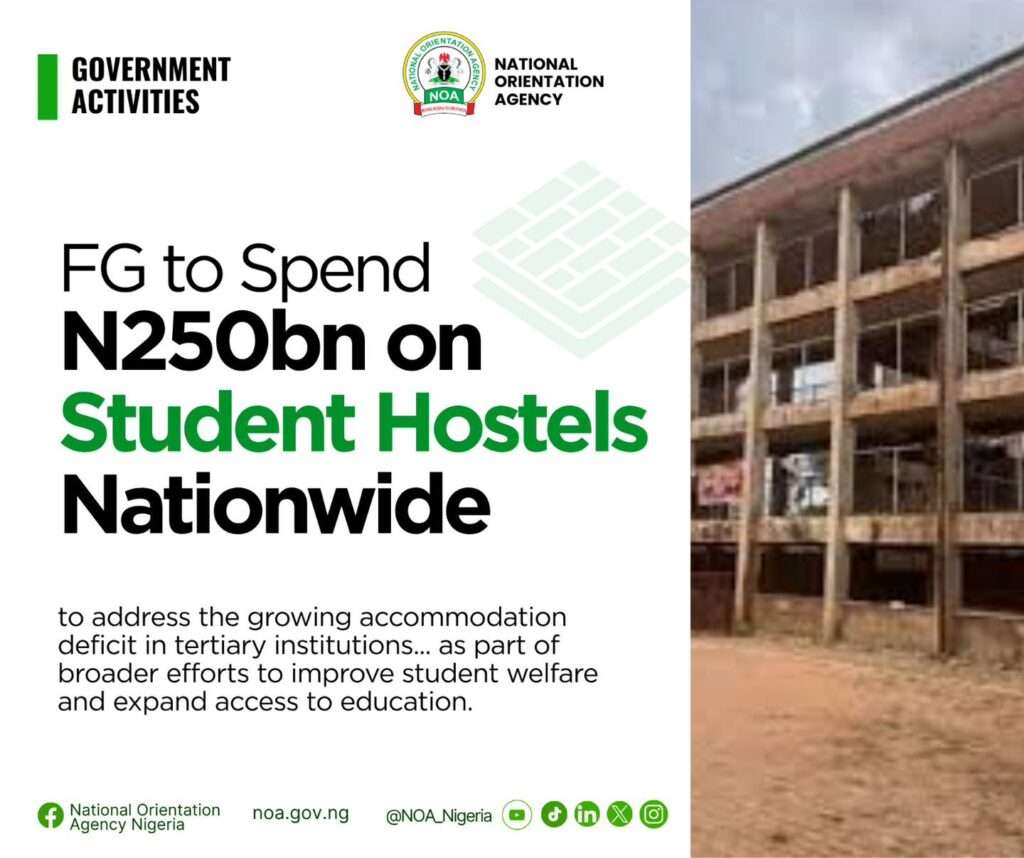
When the FG approves N250bn for the construction of student hostels nationwide, it serves as a direct, urgent response to this pandemic-level housing crisis. Students forced into off-campus markets face terrible security risks, poor infrastructure, and outrageous landlord demands. The government is finally admitting a hard truth. You simply cannot separate student welfare from academic performance. A student who commutes three hours a day through Lagos traffic cannot compete with one who sleeps securely on campus.
Breaking Down the N100 Billion Direct Funding
So, how is this massive intervention actually structured? Dr. Tunji Alausa, the Minister of Education, broke down the exact mathematics during a recent project inauguration in Abuja. It is not a blind, scattered rollout. The government is using a highly calculated, multi-layered funding strategy primarily channeled through the Tertiary Education Trust Fund (TETFund).
Of the total budget, about ₦100 billion is allocated to standard institutional funding. This means at least 50 tertiary institutions will receive a direct grant of ₦2 billion each. Each of these ₦2 billion grants is strictly mandated to deliver at least 500 brand-new bed spaces. This aggressive, straightforward push is exactly why everyone in the education sector is talking about the FG approving N250bn for student hostel construction nationwide.
The Power of Public-Private Partnerships (PPP)
But the government knows that standard public funding isn’t enough to bridge the massive gap. We desperately need private sector efficiency and speed. Therefore, a significant portion of this project relies heavily on public-private partnerships (PPPs). Specifically, 24 federal tertiary institutions will benefit from massive Build-Operate-Transfer (BOT) arrangements.
In this model, TETFund provides a ₦1 billion counterpart fund for each school. Then, private investors add another ₦3 billion to the pot. That creates a massive ₦4 billion pool for a single campus development. These PPP models will deliver between 1,200 and 1,500 premium bed spaces per institution.
Strict Timelines: When Do Students Move In?
Nigerians are naturally skeptical of large government construction projects. We have all seen abandoned, weed-infested buildings rotting away on various campuses. So, what is the actual timeline here? Are we waiting five years for a bed? The Minister was very clear about fast-tracking these developments. They are not waiting around.
For the directly funded, smaller 500-bed hostels, the completion timeline is set at strictly under 12 months. That means students could literally be moving in by the next academic session. For the massive, complex PPP projects, contractors have a strict 24-month deadline. When the FG approves N250bn for student hostel construction nationwide, they actively attach hard deadlines to ensure students feel comfortable as soon as humanly possible.
Integration with the New Student Loan Scheme
Building the hostels is one thing, but can the average student afford the new rent? This is where the administration’s broader educational strategy comes into play. The government has confirmed that the ongoing Nigerian Student Loan Scheme is fully integrated with this housing initiative.
Indigent students will not be left out in the cold. The student loan structure now actively covers accommodation costs alongside basic tuition. According to recent reports, over ₦200 billion has already been disbursed to institutions for fees, with an extra ₦50 billion dedicated as direct upkeep support. This ensures that when these beautiful new hostels open their doors, brilliant students from low-income backgrounds will have a guaranteed spot.
Read: University first-year students face accommodation crisis
Groundbreaking Moves at LASU and YABATECH
This project has already left the dusty paperwork stage. The soil is actually turning. Dr. Alausa recently led the high-profile groundbreaking ceremonies at Lagos State University (LASU) and YABATECH. At LASU, the vice-chancellor, Prof. Ibiyemi Olatunji-Bello, celebrated the commencement of their massive 1,500-bed PPP facility. It is an absolute game-changer for the densely populated Ojo campus.
Over at YABATECH, the rector, Dr. Ibraheem Abdul, noted that this intervention is a vital lifeline. His institution recently had to lock down an old 1,000-bed hostel for urgent, unavoidable renovations, worsening its deficit. This immediate, physical construction proves the reality behind the headline that the FG has approved N250bn for the construction of student hostels nationwide.
Beyond Hostels: Powering Campuses and Tech Upgrades
Interestingly, the government’s intervention extends beyond simply providing students with a place to sleep. A modern student needs modern infrastructure to truly thrive. While inspecting the LASU project, the Minister dropped another massive piece of news that flew under the radar.
The government is committing an extra ₦24 billion to build independent power plants for the university. This will finally guarantee a 24-hour, uninterrupted power supply, saving the school hundreds of millions in diesel costs annually. Furthermore, the national budget includes a whopping ₦130 billion for upgrading engineering and technology workshops, as well as ₦120 billion for medical schools across the country. It is a holistic, aggressive approach to saving the entire tertiary education sector.
A New Era of Administrative Accountability
Throwing money at a problem doesn’t solve it if the leadership is weak. The Ministry of Education is well aware of this fact. Alongside the financial rollout, the Minister officially inaugurated several new governing boards, principal officers, and chief executives of key educational agencies in Abuja.
Agencies such as the National Board for Technical Education (NBTE) and the National Examinations Council (NECO) now have new leadership mandates. Dr. Alausa explicitly charged these newly inaugurated board members to ensure strict accountability and improve institutional performance. They are expected to closely monitor these construction projects and ensure that every single naira is directly translated into a physical, usable bed space for a student.
Conclusion
We are finally seeing a structured, heavily funded attempt to fix a crisis that has plagued Nigerian students for decades. Decent, safe accommodation is a fundamental right, not a luxury reserved for the elite few. By bringing in private investors and setting strict, verifiable delivery timelines, the Ministry of Education is completely changing the narrative.
We will keep a very close eye on these contractors to ensure they deliver on these promises without cutting corners. But for now, the future of campus living looks incredibly bright.
What are your thoughts on this massive funding? Do you think the PPP model is the best way to solve our campus housing crisis? Share your opinions in the comments below, and don’t forget to share this post with your fellow students!
Related:
FG Scraps UTME Requirement For NCE Candidates in 2026 Policy Meeting
Hope Arises as NUC Assures Action on NYSC Mobilisation for NOUN Graduates
Strategic Collaboration: Ugandan Exam Board Visits Nigeria to Understudy NABTEB TVET Model
YEIDEP 2026: Recruitment, Registration, and Everything You Should Know Before You Apply