
Let’s be completely honest for a second. Finding a decent, affordable place to live in Africa is incredibly difficult right now. The population is booming. Cities are overflowing. Rent prices are absolutely ridiculous. Millions of people are still stuck on endless government waiting lists for basic housing. Traditional brick-and-mortar buildings are just too slow and way too expensive to keep up with the demand. But what if we could simply print a house? It sounds like science fiction. Yet, it is happening right now. This is exactly why the UJ 3D concrete printing technology is turning so many heads across the continent.
Down in South Africa, the University of Johannesburg (UJ) decided to stop talking about the housing crisis and actually do something about it. They did not just write another academic paper. Instead, they brought a massive, robotic 3D printer onto their campus. Then, they successfully printed an entire six-room house. Today, we are breaking down this unbelievable campus tech innovation. We will look at how it works, who built it, and why it might just save the future of African urban development. Grab a cup of coffee. Let’s get into it.
The Real Problem with Traditional Building
Before we marvel at the robots, we need to understand the problem. Why do we even need to print houses? Think about how we currently build homes. You hire a large crew of bricklayers. They mix cement manually. They lay every single brick by hand, one by one.
This traditional process takes months. Weather delays slow things down. Materials get stolen from the construction site. Human error leads to crooked walls and wasted cement. All these factors add up. Ultimately, they make building a simple home incredibly expensive.
For the average citizen, building a house from scratch is a financial nightmare. African governments are also struggling. They simply cannot build subsidized housing fast enough to clear the massive backlogs. We clearly need a faster, cheaper, and smarter way to put roofs over people’s heads.
UJ Students Build a 3D Printed House
Meet the Masterminds at the University of Johannesburg
This is where the academics stepped out of the lecture halls and into the mud. The School of Civil Engineering and the Built Environment at the University of Johannesburg took on the challenge. Professor Jeffrey Mahachi and his brilliant team spearheaded this massive project.
They looked at construction tech happening in Europe and China. But they knew they could not just copy and paste those solutions. African environments are different. Our soil is different. Our weather patterns are harsh. They needed a homegrown solution.
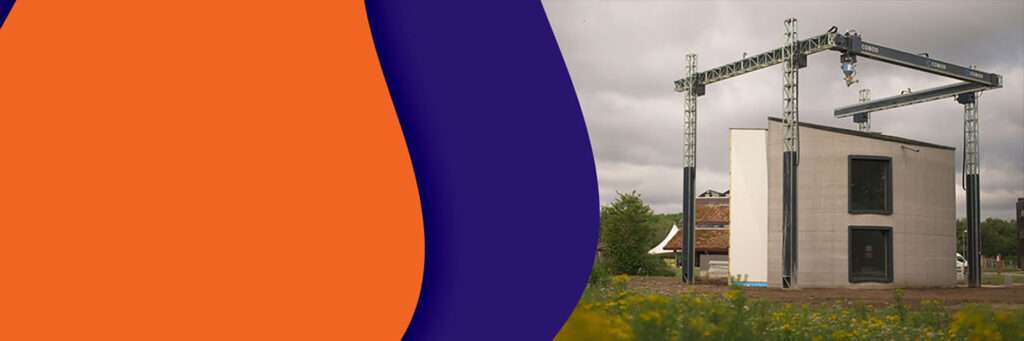
So, they secured a massive gantry-style 3D printer and set it up at their Doornfontein campus. The goal was simple but incredibly ambitious. They wanted to prove that UJ 3D concrete printing technology could produce a dignified, structurally sound home in a fraction of the time it would take with traditional methods. And they absolutely nailed it.
Breaking Down the Giant Campus Printer
So, how does a house printer actually work? If you have ever seen a small desktop 3D printer making little plastic toys, the concept is exactly the same. It is just scaled up massively.
Instead of sitting on a desk, this printer is a huge robotic gantry system. It looks like a giant metal frame that surrounds the entire building site. A large robotic arm moves along this frame along the X, Y, and Z axes.
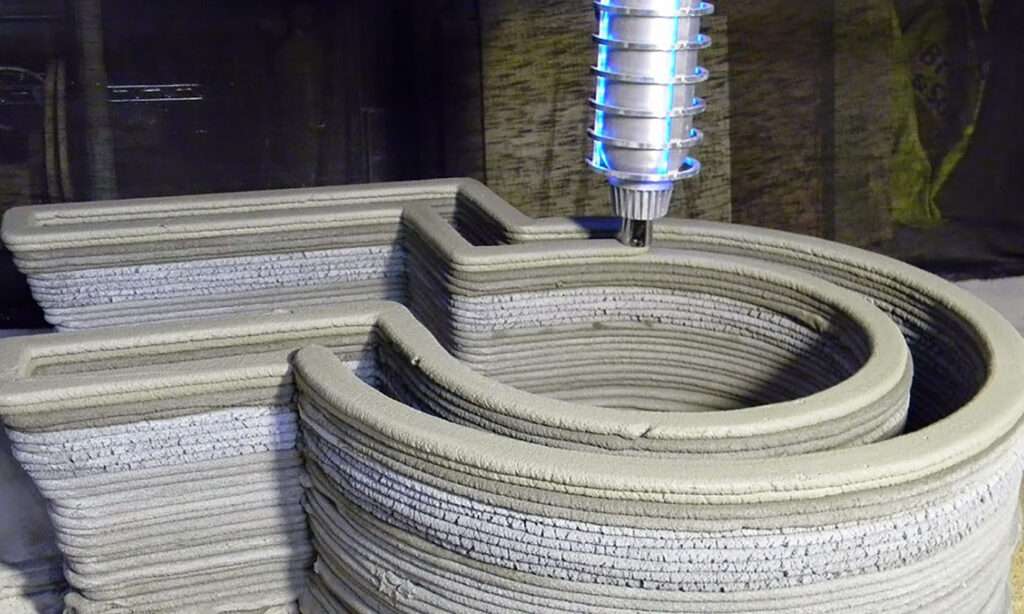
Instead of melting plastic, this giant machine extrudes wet concrete. The architects design the house on a computer using standard 3D modeling software. They send that digital file to the printer’s brain. The robotic arm then moves precisely along the mapped path, squeezing out thick layers of concrete. It builds the walls layer by layer, from the ground up.
Formulating the Perfect Concrete Mix
You cannot just pour regular building cement into a high-tech 3D printer. It will instantly clog the nozzle and ruin the machine. Therefore, the secret sauce of the UJ 3D concrete printing technology lies in materials science.
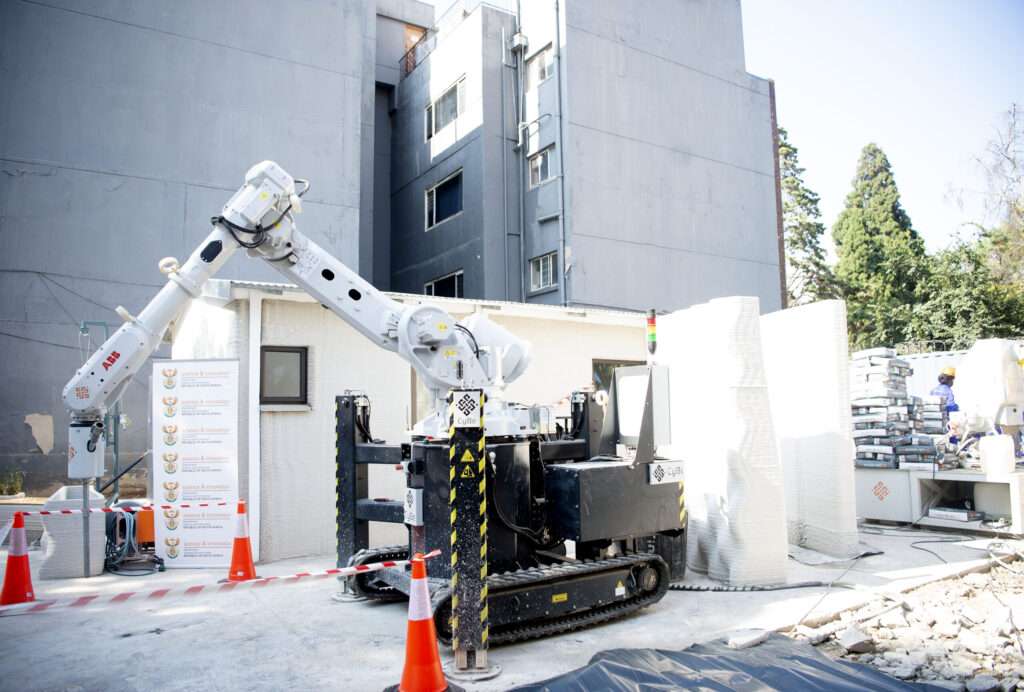
The UJ civil engineering students and researchers spent months perfecting a specialized concrete mix. This material had to meet very specific, almost contradictory requirements. First, it needed to be fluid enough to flow smoothly through the pumping hoses.
Second, it needed to set almost instantly upon leaving the nozzle. If the concrete is too wet, the bottom layers will collapse under the weight of the new layers being printed on top. If it is too dry, it will not bond properly. The team successfully engineered a fast-curing, high-strength concrete blend that stacks perfectly.
Beating the Clock with Unbelievable Speed
Now, let us talk about the speed. This is where the innovation truly shines. A typical low-cost house takes several weeks, sometimes months, to finish by hand.
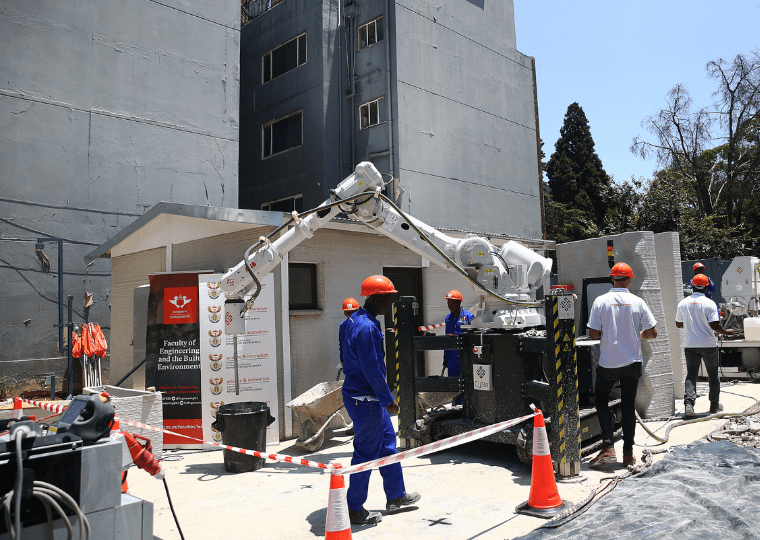
The UJ team powered up their printer and got to work. They printed the entire wall structure of a six-room house in just eight hours. Yes, you read that correctly. Eight hours. You could literally go to work in the morning and, by the time you drive home, a full house structure would be standing there.
This unbelievable speed changes everything. Imagine disaster relief scenarios. If a flood wipes out a community, the government can deploy these printers to rebuild an entire village in a matter of days. It completely redefines emergency housing and urban planning.
Read More Here: UJ Civil Engineering showcases 3D-Printed Housing at Presidential IBT Summit
Slashing Costs for the Average Citizen
Speed is great, but affordability is the real goal. Does this high-tech robot make houses cheaper? Absolutely. Adopting the UJ 3D concrete printing technology dramatically slashes overall construction costs.
First, it reduces material waste. Traditional builders always order extra bricks and cement to account for breakages and human error. The 3D printer, however, calculates exactly how much material the design requires. It uses exactly that amount. Nothing more. Nothing less.
Second, it cuts down massive labor costs. You no longer need a crew of twenty bricklayers working for a month. You only need a small team of three or four trained technicians to monitor the machine and manage the concrete supply. These massive savings can be passed down directly to the final homeowner.
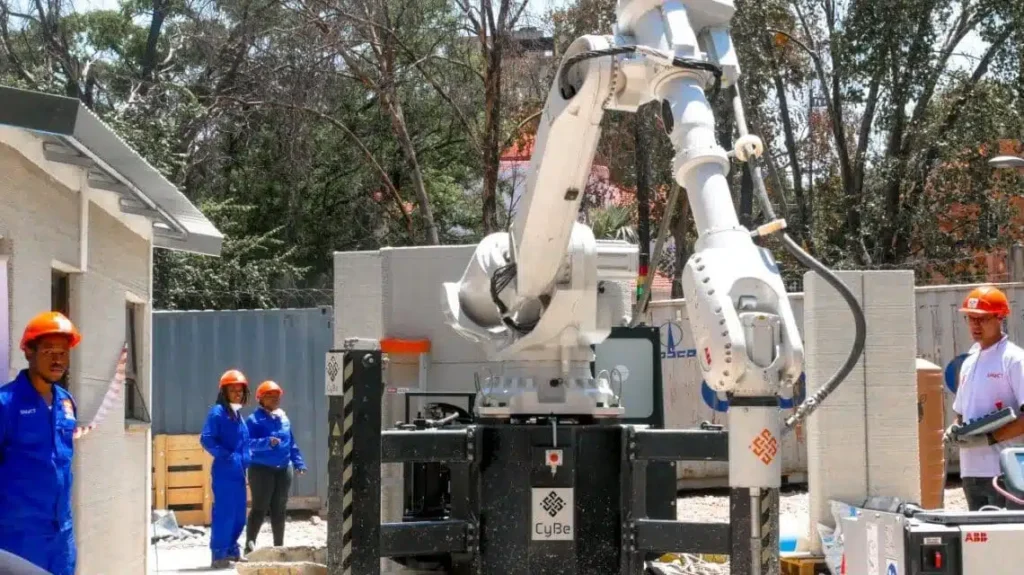
Note:
CyBe Construction is the official manufacturer of the 3D concrete printer—specifically the CyBe RC (Robot Crawler)—used by the university. Click HERE to read the technical specifications regarding the machine’s speed, the 45-square-meter printing area, and the 8-hour print time.
The Environmental Win We Desperately Need
We cannot ignore the environmental impact of construction. The building industry has historically been one of the largest polluters on the planet. Cement production generates massive carbon emissions. Construction sites create tons of physical waste that ends up in local landfills.
This campus innovation offers a much greener alternative. Because the printer uses exact material quantities, there is virtually zero site waste. No broken bricks. No leftover concrete drying up in the sun.
Furthermore, the UJ researchers are actively exploring ways to incorporate recycled materials into their concrete mix. They are testing the inclusion of recycled plastics and eco-friendly additives. This means future homes could literally help clean up our environment while providing shelter.
Moving Beyond the Basic Square Box
Let’s face it. Most low-cost government housing looks terrible. They are usually just boring, rigid square boxes. Traditional bricklaying makes curved walls and complex designs very expensive and difficult to execute.
The 3D printer does not care about complexity. A curved wall costs exactly the same to print as a straight wall. It just takes a different line of code in the software.
This freedom allows architects to design beautiful, organic, and culturally relevant homes for low-income families. The UJ printed house features smooth, curved edges and a modern aesthetic. It proves that affordable housing does not have to look cheap or ugly. Everyone deserves a home they can be proud of.
Empowering Students with Hands-On Tech
Beyond the physical building, this project is a massive win for African education. For too long, engineering students in Africa have only studied advanced technologies in textbooks. They rarely got to touch the equipment.
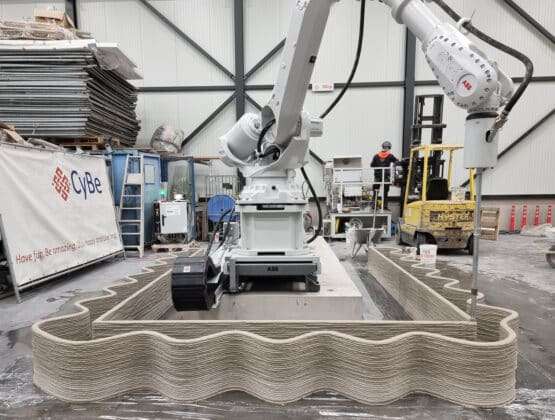
The UJ 3D concrete printing technology changes that narrative. Students at the university are getting their hands dirty with cutting-edge robotics. They are learning software coding, material science, and automated construction management all at once.
When these students graduate, they won’t just be looking for jobs. They will be highly sought-after experts in a totally new industry. They are the pioneers who will eventually launch their own automated construction startups across the continent.
Overcoming Initial Skepticism and Fears
Of course, any new technology faces pushback. When UJ unveiled this project, some people immediately raised concerns. The biggest fear? Job losses. Trade unions worry that robots will steal jobs from human bricklayers and manual laborers.
It is a valid concern. However, the UJ team is quick to clarify that this tech evolves the workforce; it doesn’t erase it. We still need humans to design the homes. Plumbers, electricians, and roofers are also needed. We need trained technicians to operate and repair the printers.
The goal is to upskill the workforce. Instead of doing back-breaking manual labor under the hot sun, a former bricklayer can be trained to operate the robotic interface. It shifts the labor from purely physical exertion to technological management.
Tackling the Integration of Basic Utilities
Printing the walls is a massive achievement. But a house is not a home without water and electricity. How do you put pipes into a solid printed wall?
The engineering team thought ahead. The printer creates hollow cavities within the walls as it builds upwards. These calculated gaps serve a dual purpose.
First, they act as natural thermal insulation, keeping the house cool in the summer and warm in the winter. Second, they provide perfect, pre-made channels for electricians and plumbers to run their wires and pipes. The traditional builders simply come in after the printing is done and easily slot the utilities into place.
Government Interest and Scaling Up
A university project is wonderful, but it needs government backing to reach the masses. The South African government is already paying close attention. The Department of Science and Innovation strongly supports this initiative.
They recognize that scaling up the UJ 3D concrete printing technology could finally put a dent in the national housing backlog. The government is currently exploring policy frameworks to officially certify 3D-printed homes.
Once the building regulators finalize the safety codes and approve these structures for the mass market, the floodgates will open. We could see fleets of these printers moving into townships and rural areas, rapidly upgrading informal settlements into planned, durable neighborhoods.
The Broader Impact on the African Continent
This breakthrough at UJ is not just a win for South Africa. It is a powerful beacon of hope for the entire African continent. Nigeria, Kenya, Ghana—every rapidly urbanizing African nation faces the exact same housing deficit.
By perfecting this tech locally, UJ proves that Africa does not need to constantly import solutions from the West. We can innovate right here on our own campuses.
As other universities take note, we expect to see collaborative research sharing. Imagine engineering faculties across Africa partnering up to refine the concrete formulas for different local climates. When we fully embrace UJ 3D concrete printing technology as a standard tool, the continent’s urban landscape will transform incredibly fast.
Looking Ahead: What Comes Next?
The University of Johannesburg is not slowing down. They proved they could print a single-story house. Now, the researchers are looking at the next big challenge.
They are actively working on printing multi-story structures. They are also testing different architectural layouts and exploring solar roof integrations. The ultimate vision is a fully sustainable, off-grid, 3D-printed smart home that costs less than a standard used car.
It sounds ambitious. But after watching them print a six-room house in less than a day, betting against them seems foolish. The future of African construction is here. And it is completely automated.
Conclusion
The housing crisis often feels like an impossible puzzle. But innovation always finds a way. The brilliant minds at the University of Johannesburg stepped up and delivered a practical, mind-blowing solution. They showed us that technology can be deeply human, providing dignity and shelter to those who need it most.
The days of laying single bricks for months on end are slowly coming to a close. Automated construction is fast, eco-friendly, and highly affordable. This campus breakthrough gives us real, tangible hope for a better-built Africa. Let’s keep cheering on these young engineers. They are literally building our future, one printed layer at a time.
Did this campus tech breakthrough blow your mind? Share this post with your network, drop your thoughts in the comments, and don’t forget to subscribe for more amazing African tech stories!
Related:
Top Tech Innovations From Nigerian Universities in 2026
How Students Are Making Money Through Tech in Nigeria
Why Everyone is Talking About the YABATECH Electric Tricycle and AI Platform