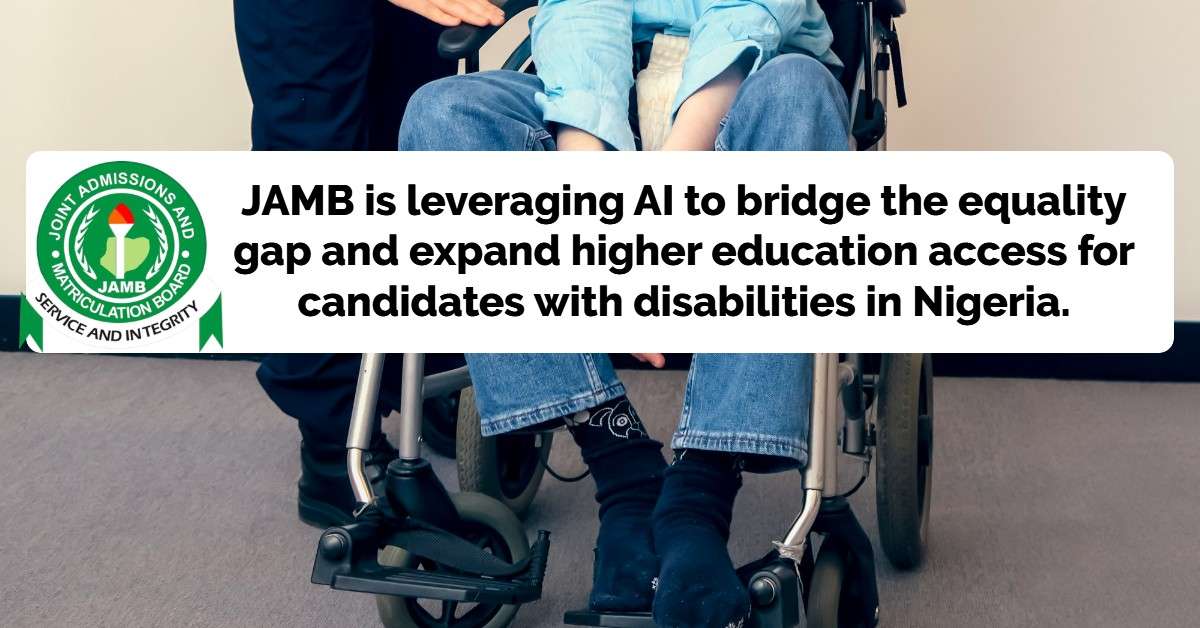
For years, candidates with disabilities have faced systemic barriers when seeking access to higher education. However, a major technological and policy shift is currently underway in Nigeria. The Joint Admissions and Matriculation Board (JAMB) has officially set its sights on Artificial Intelligence (AI) as the ultimate tool to democratize education and create a level playing field for every single candidate.
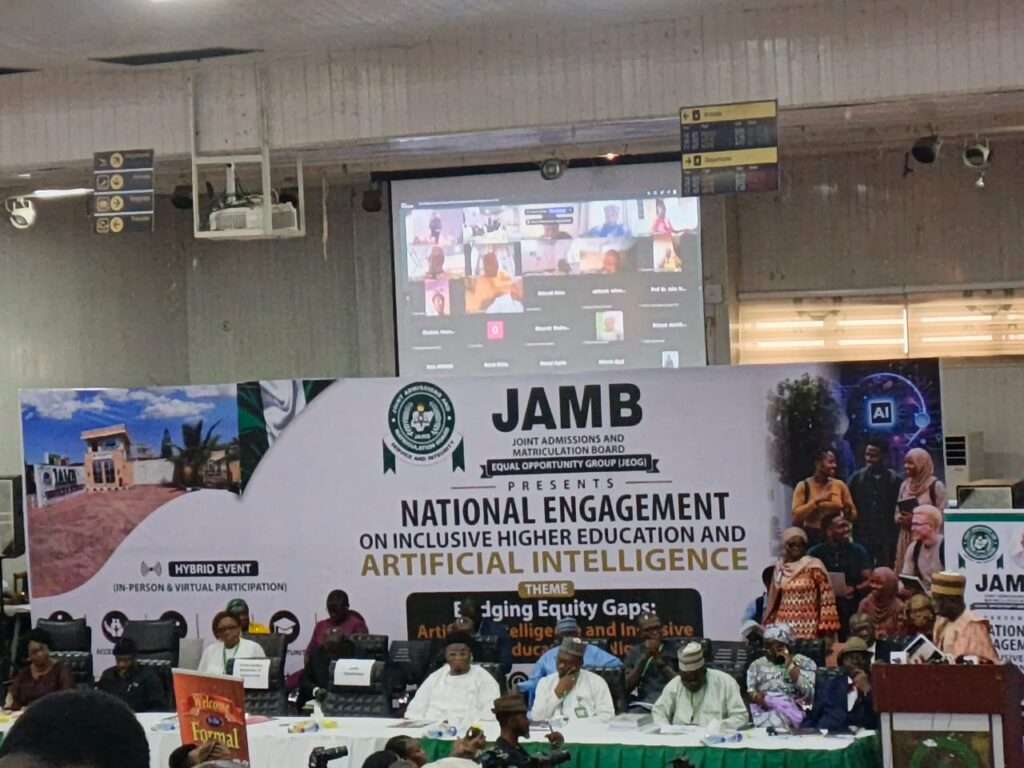
Recently, education stakeholders gathered in Abuja at the National Universities Commission (NUC) headquarters for the National Engagement on Inclusive Higher Education and Artificial Intelligence. Organised by the JAMB Equal Opportunity Group (JEOG), this landmark event operated under the theme: “Bridging Equality Gaps: Artificial Intelligence and Inclusive Higher Education in Nigeria.”
Here is a detailed breakdown of how JAMB plans to use AI to reshape the Unified Tertiary Matriculation Examination (UTME) and what this means for the future of inclusive education in Nigeria.
1. AI as the Next Frontier in Educational Equality
During the stakeholder engagement, the outgoing JAMB Registrar, Prof. Is-haq Oloyede, emphasized that the deployment of Artificial Intelligence is critical for expanding access for persons with disabilities.
Prof. Oloyede provided a highly pragmatic perspective on the technology. He noted that AI is inherently value-neutral—much like the internet or a mobile phone—and its ultimate impact depends entirely on how it is applied.
- Democratization of Knowledge: According to Oloyede, AI presents one of the greatest existing opportunities for the democratization of knowledge.
- Irreplaceable Human Element: He stressed that while there is no escaping AI, the technology cannot replace humans unless those humans fail to understand and utilize it for good causes.
- Practical Solutions: He urged educational institutions to move beyond mere discussions and begin translating AI knowledge into practical solutions that improve teaching, learning, and accessibility.
2. Transforming the UTME Process for Special Needs Candidates
The Chairman of JEOG, Emeritus Prof. Peter Okebukola, elaborated on exactly how AI will solve persistent operational challenges during the UTME.
Currently, JAMB manually adapts its examinations by providing Braille materials, dictation by subject experts, and excluding diagram-based questions for visually impaired candidates. Moving forward, AI will automate and perfect this process:
- Instant Question Adaptation: Prof. Okebukola explained that an AI algorithm can be programmed to instantly dive into the UTME item bank (for subjects like Biology) and automatically select equivalent questions that do not rely on diagrams.
- Maintaining Standards: In a matter of milliseconds, the AI can generate a highly appropriate set of alternative questions while strictly maintaining the exact same learning objectives and level of difficulty.
- Deliberate Design: Okebukola warned that AI only benefits persons with disabilities when its design is deliberate and when tech developers work hand-in-hand with special education professionals.
No Special Cut-Off Marks
Despite these accommodations, JAMB remains uncompromising on academic standards. Prof. Okebukola explicitly clarified that the board does not lower cut-off marks or standards for candidates with disabilities. They answer the same questions and are assessed by the same rigorous standards as every other candidate.
3. A Decade of the JAMB Equal Opportunity Group (JEOG)
The event in Abuja also served as a 10-year anniversary review of JEOG, a specialized committee established by Prof. Oloyede to support candidates with special needs.
The statistics from the past decade are incredibly inspiring:
- Candidates Supported: Since its inception, JEOG has supported 4,216 candidates with various disabilities, including visual impairment, albinism, autism, and Down syndrome.
- High Admission Rates: On average, an impressive 53% of these participating candidates successfully secure admission into universities, polytechnics, and colleges of education every year.
- Professional Excellence: Many of these beneficiaries have gone on to excel in highly competitive disciplines, including Law and Medicine, proving that disability is never a barrier when adequate support is provided.
- Logistical Support: Beneficiaries of the JEOG initiative receive free transportation, accommodation, and assistive devices during their examinations to ensure they compete on an equal footing.
4. Institutional Backing: NUC and NBTE Step Up
The push for AI and inclusivity extends beyond JAMB. Regulatory bodies across Nigeria’s tertiary education sector are also actively updating their frameworks.
- The National Universities Commission (NUC): Representing the NUC Executive Secretary, Dr. Lawal Faruk noted that universities must prepare graduates for an AI-driven world without leaving anyone behind. The NUC has officially embedded inclusion into its ongoing reforms through the Core Curriculum and Minimum Academic Standards (CCMAS).
- The National Board for Technical Education (NBTE): Aliyu Hassan, representing the NBTE, revealed that the board is already developing a National Diploma in Artificial Intelligence. Furthermore, they are reviewing the Higher National Diploma (HND) curriculum to align with these emerging technologies.
5. Celebrating Legacy and Looking Ahead
As part of the stakeholder engagement and to honor the outgoing Registrar, Prof. Is-haq Oloyede, two significant publications were unveiled:
- A Peep into the Future of Higher Education in Nigeria: A book edited by Prof. Okebukola featuring contributions from 44 scholars, offering practical recommendations for repositioning the sector over the next decade.
- A Guide for Underage Students: A manual developed through extensive consultations with scholars and underage students to help parents and universities support exceptionally young undergraduates (such as the recent cohort of 96 students below age 16) with emotional adjustment and social integration.
To cap off the event, JAMB presented awards to tertiary institutions that admitted the highest number of candidates with disabilities, recognized the top-performing UTME candidates with special needs, and honoured outstanding IT staff members for their dedication to improving the board’s operations.
The integration of AI into Nigeria’s educational framework is no longer a distant dream; it is an active, ongoing reality. With institutions like JAMB leading the charge, the future of higher education in Nigeria is set to become more accessible, fairer, and beautifully inclusive.
Click the link below to watch the news update from TVC News:
JAMB To Make Higher Education More Inclusive For PWDs
Interestingly, this news report provides additional coverage of JAMB’s recent stakeholder engagement on making higher education more inclusive for Persons With Disabilities in Nigeria.
For years, candidates with disabilities have faced systemic barriers when seeking access to higher education. Not any more!
Recommended:
Why Do Pupils With Autism Need Unregulated Education
2026 UTME: Is The JAMB Concession A Cancellation Or A Suspension?
The 33-Year Reunion Of Military Students
Related posts:

JAMB CBT Practice Software Recommendations and Mock Analysis Guide
25 Things You Should Know About The JAMB 2025 UTME Exams

I Printed The Result From JAMB Portal-Mmesoma

JAMB Dismisses Refund Demands as Candidates Incur Charges Checking Delayed Results
JAMB Takes Over HND Admissions in Polytechnics (Complete Guide 2026)