
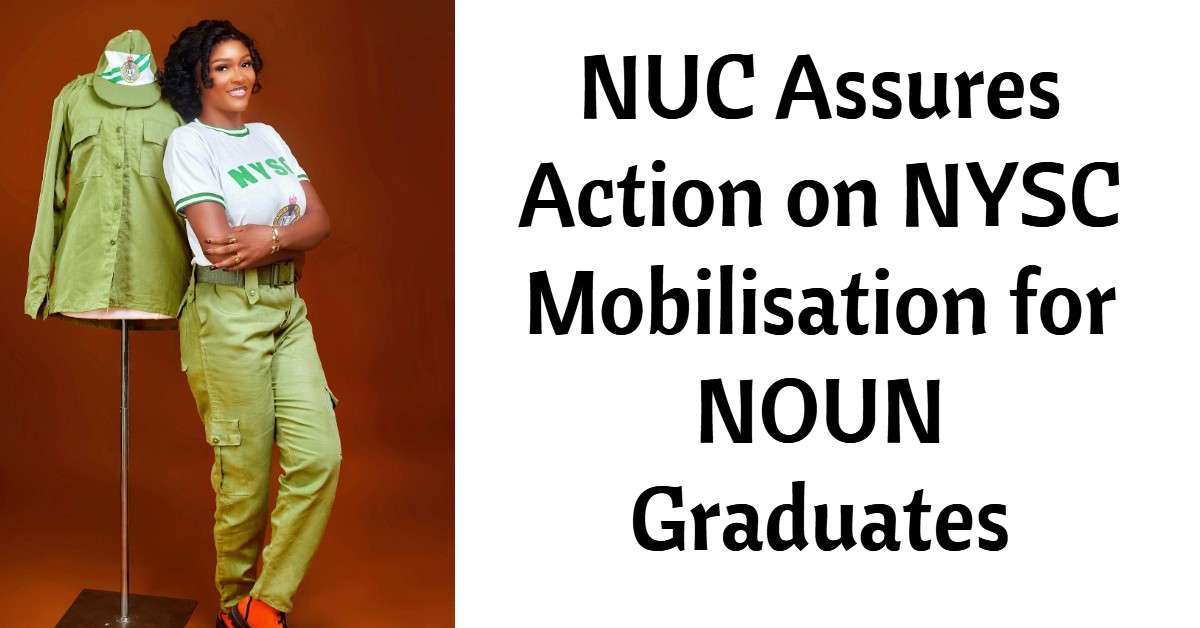
The National Universities Commission (NUC) has brought a massive wave of relief to thousands of students across Nigeria. Recently, the commission officially announced that it will actively review the long-standing exclusion of students from the National Open University of Nigeria (NOUN) from the national service scheme. Securing NYSC mobilisation for NOUN graduates has remained a deeply contested issue for several years.
Currently, these graduates receive exemption letters rather than the traditional call-up letters. However, this outdated policy is finally about to change for the better. On Saturday, April 18, 2026, educational stakeholders gathered in Abuja to discuss this critical matter directly. The authorities promised to right this historical wrong.
Consequently, this blog post explores recent official declarations, the university’s changing demographics, and the projected timeline for this much-awaited policy shift.
The Renewed Push for National Service Inclusion
For many years, graduates of the open university system faced significant barriers in the Nigerian labour market. Corporate employers often demand the official discharge certificate from the National Youth Service Corps (NYSC) before offering permanent jobs. Therefore, the lack of NYSC mobilisation for NOUN graduates created an unfair professional disadvantage. The students worked just as hard as their peers in conventional universities. Yet, they faced systemic discrimination immediately after graduation.
Fortunately, the NUC’s leadership has officially stepped in to resolve this anomaly. Professor Abdullahi Ribadu, the Executive Secretary of the NUC, recently addressed this burning issue publicly. He represented President Bola Ahmed Tinubu at the university’s 15th convocation ceremony. During his address, he delivered a highly encouraging message to the anxious students. He firmly assured the public that the commission will immediately open high-level discussions with the NYSC leadership. Their primary goal is to successfully re-evaluate the existing mobilisation framework.
Understanding the Changing Demographics of NOUN Students
To understand why this policy shift is happening now, we must look at the data. Historically, the open university system primarily served older working professionals. Many decades ago, the average student at the institution was well over 30 years old. Because the NYSC scheme strictly limits participation to graduates under 30, the initial exclusion made sense.
However, the educational dynamics in Nigeria have changed dramatically. Today, the university admits thousands of young secondary school leavers. Professor Ribadu explicitly acknowledged this massive demographic shift during his speech. He noted that the commission now observes a massive influx of students who are significantly younger. Consequently, many of these young scholars graduate long before they hit the 30-year age limit. Because of this undeniable fact, achieving NYSC mobilisation for NOUN graduates is no longer a privilege; it is a statutory right.
Presidential Support for Open and Distance Learning
The push for equitable treatment enjoys the full, unwavering backing of the Nigerian federal government. During the recent convocation, President Tinubu reaffirmed his strong commitment to expanding access to higher education. He heavily praised the Open and Distance Learning (ODL) framework. According to the President, the institution effectively democratizes education for all Nigerians.
Currently, the Joint Admissions and Matriculation Board (JAMB) conducts examinations for over 2 million candidates annually. Unfortunately, conventional universities can only admit a tiny fraction of these hopeful applicants. Consequently, NOUN provides a highly critical alternative platform for higher learning. With over 500,000 active students nationwide, it ranks among the largest open universities in Africa. The President promised that his administration will continue to support the institution in becoming globally competitive.
Read: Check Your JAMB UTME 2026 Result
The Chancellor Appeals for Fairness and Equity
The institution’s traditional leadership also played a crucial role in sparking this recent policy review. His Royal Majesty, Oba Ewuare II, the Oba of Benin, currently serves as the university’s Chancellor. During his address, the revered monarch passionately advocated for the immediate welfare of the students. He boldly called the federal government’s attention to the unequal treatment of the graduates.
The Chancellor strongly emphasized that current restrictions severely punish innocent students simply because of their chosen mode of study. He demanded total fairness and equal opportunity for every Nigerian graduate. Furthermore, he directly urged the relevant authorities to quickly remove all administrative impediments. His powerful royal intervention clearly accelerated the NUC’s decision to pursue the NYSC mobilisation for NOUN graduates aggressively.
The Deep Value of the National Youth Service Corps
Why does the NYSC matter so much to these young graduates? The Nigerian government originally established the scheme in 1973 to vigorously promote national unity. The program deliberately deploys young graduates to states outside their home regions. This strategic deployment strongly fosters cultural integration and deep mutual understanding among Nigerian youths.
Beyond cultural integration, the scheme provides vital practical experience. Corps members actively serve in schools, rural hospitals, and government agencies. This one-year mandatory service frequently acts as a vital bridge between theoretical classroom learning and actual professional practice. By denying open university students this crucial experience, the nation indirectly robs itself of diverse, energetic talent. Therefore, reversing this exclusion will massively benefit the overall Nigerian economy.
Breaking Down the 15th NOUN Convocation Ceremony
The recent announcements were made amid a highly celebratory atmosphere in Abuja. The 15th convocation ceremony of the university was a truly massive, spectacular event. The Vice-Chancellor, Professor Uduma Oji Uduma, proudly presented the institution’s academic achievements to the world. A staggering 24,575 students graduated across various academic levels.
Specifically, the university awarded 17,474 undergraduate degrees. Additionally, they awarded 1,788 postgraduate diplomas, 5,282 master’s degrees, and 31 prestigious doctoral degrees. Breaking down the undergraduate performance further, 57 exceptional students achieved First Class Honours. Another 2,505 students obtained Second Class Upper degrees. These impressive numbers practically prove that the university maintains rigorous academic standards comparable to those of any conventional institution.
Massive Technological Advancements at the University
Delivering quality education to over half a million students requires sophisticated technology. The Vice-Chancellor used the convocation to highlight the university’s massive digital evolution. To efficiently manage its growing student population, the management recently migrated its core institutional systems to Amazon Web Services (AWS). This bold technological transition effectively resolved previous challenges relating to scalability and data security.
Furthermore, the university currently runs the largest single-instance Moodle-based Learning Management System in the entire West African sub-region. This robust system comfortably supports over 180,000 active users simultaneously. Every single semester, the academic staff successfully delivers more than 2,000 unique courses online. These massive infrastructural upgrades prove that the graduates are highly trained, digitally literate, and fully ready for the modern workforce.
Expanding Access to Marginalised Communities
One of the most inspiring aspects of the open university system is its radical inclusivity. The institution does not just cater to regular students. It actively extends educational lifelines to marginalized and unconventional groups. For example, the university heavily supports working professionals, active military personnel, and busy civil servants. It allows them to systematically upgrade their knowledge without abandoning their vital national duties.
Most impressively, the university provides full degree programs to inmates inside Nigerian correctional facilities. During the ceremony, the Vice-Chancellor explicitly celebrated the inclusion of these graduating inmates. He correctly described it as concrete proof of education’s powerful rehabilitative capacity. By transforming lives across all societal levels, the university constantly proves its massive value to the Nigerian state.
The Road Ahead for Policy Implementation
While the official promises are highly encouraging, students must understand that bureaucratic changes require time. The NUC cannot unilaterally dictate terms to the NYSC management board. Instead, both critical agencies must sit down to draft a new, comprehensive Memorandum of Understanding. They must carefully align their digital databases to successfully verify the ages of prospective corps members.
Consequently, students should patiently await further official directives. The NUC promised to move swiftly, but they must also meticulously follow due process. The successful implementation of the NYSC mobilisation for NOUN graduates will likely roll out in carefully managed phases. The authorities will likely start by automatically mobilizing the youngest graduates first, before gradually expanding the deployment net.
Continued Government Investment in Infrastructure
To sustain this massive educational progress, continuous funding remains absolutely vital. Chancellor Oba Ewuare II correctly noted that open learning relies heavily on physical study centers. Currently, the university operates a vast network of study centers across the entire Nigerian federation. However, these facilities require ongoing modernization and digital enhancements to operate at optimal capacity.
The federal government must view this funding as a highly strategic investment in human capital, not just a recurrent cost. Furthermore, the Tertiary Education Trust Fund (TETFund) is currently stepping in to help. They are actively extending high-speed internet connectivity to dozens of study centres nationwide. This targeted infrastructural support will ultimately ensure that the graduates remain globally competitive and professionally competent.
Conclusion
In conclusion, the future looks incredibly bright for the National Open University of Nigeria. The recent public declarations by the NUC forcefully demonstrate a renewed commitment to educational fairness. Young Nigerians who chose the flexible path of distance learning will no longer face unjust systemic discrimination. The federal government finally recognizes their hard work, academic rigor, and undeniable potential.
The impending policy shift regarding the NYSC mobilisation for NOUN graduates is a massive victory for equity. It ensures that every eligible Nigerian youth gets a fair chance to serve their beloved country. As the agencies finalize the administrative details, the students can finally breathe a deep sigh of relief. The days of settling for mere exemption letters are rapidly coming to an end.
Did you find this detailed update helpful? Share this post with your classmates, friends, and family to keep them informed! Also, subscribe and read more of our detailed educational guides to stay completely ahead of the curve.
Related:
Historic Milestone: UNIBEN Gets Full NUC Accreditation For All Degree Programmes
Complete List of Universities in Nigeria: A Comprehensive Guide 2026
NYSC 2026: What influenced my decision to serve in this state