
The cost of secondary education in Nigeria remains a major topic of discussion among families today. Recently, parents and students received news that sparked nationwide anxiety. The Federal Ministry of Education announced plans to significantly raise examination fees. However, public pressure quickly altered this policy direction. The Federal Government has now officially suspended the controversial review of WAEC and NECO registration fees.
The Ministry of Education withdrew the circular that authorized the price adjustment. Consequently, candidates preparing for upcoming senior school certificate examinations will continue paying the existing rates. Education authorities will now engage in broader consultations before taking further action.
Let us examine the initial proposal, explore the reasons behind the planned increase, and analyze why the government suspended the policy.
Understanding the Proposed Review of WAEC, NECO Registration Fees
The controversy began when the Federal Ministry of Education issued a policy letter on June 18, 2026. This document communicated a sharp increase in the costs of national exit examinations. Specifically, the government targeted the 2027 West African Senior School Certificate Examination (WASSCE) and the Senior School Certificate Examination (SSCE). The West African Examinations Council (WAEC) conducts the WASSCE. Similarly, the National Examinations Council (NECO) administers the SSCE.
Under the new proposal, the government planned to raise registration charges from N27,500 to N50,000 per candidate. This adjustment represented an 82 percent price hike. The authorities intended to enforce this rate starting from the 2027 academic session. Naturally, school proprietors and parents reacted with immediate concern.
The Ministry of Education initially defended the initiative. Officials stated that macroeconomic factors necessitated the financial adjustment. Furthermore, they emphasised that exam tariffs had remained static for several years. The ministry argued that the old fee structure could no longer support modern operational realities. Therefore, the authorities viewed the review of WAEC and NECO registration fees as a vital survival strategy for the examination bodies.
Why the Government Initially Proposed the Fee Hike
To understand the controversy, we must look at the operational costs of public examination bodies. Conducting national examinations across thirty-six states and the Federal Capital Territory requires immense financial resources. Both WAEC and NECO face severe economic headwinds.
1. Rising Logistics and Transportation Costs
Logistics form a huge part of examination administration. Exam officials must distribute sensitive materials to thousands of centers nationwide. However, the cost of transportation has increased drastically over the past two years. Fuel price adjustments have pushed distribution expenses to unprecedented levels. Consequently, examination councils spend significantly more money on vehicle hire and fuel.
2. High Cost of Security in Conflict Zones
Security challenges also complicate examination delivery in several regions. Examination bodies must protect supervisors, students, and question papers from security threats. In some areas, authorities deploy armed security personnel to safeguard examination venues. Moreover, secure storage facilities require constant monitoring and surveillance. These protective measures consume a large chunk of the operational budgets of both examination councils.
3. Printing and Paper Importation Expenses
Printing millions of question papers and answer booklets requires specialized paper and ink. Nigerian examination bodies import a significant portion of these high-grade printing materials. However, foreign exchange rate fluctuations have affected import costs severely. The devaluation of the Naira has multiplied the cost of paper procurement. Therefore, printing costs contributed heavily to the proposed review of WAEC, NECO registration fees.
4. Technology Deployment and Biometric Verification
Modern examination administration relies heavily on technology. WAEC and NECO now utilize biometric scanners to curb examination malpractice. In addition, the councils are gradually introducing Computer-Based Testing (CBT) formats for objective papers. Developing digital infrastructure requires massive capital investment. The examination bodies also spend heavily on server maintenance, cybersecurity, and software licenses.
5. Quality Assurance and Examiners’ Allowances
Maintaining academic integrity requires rigorous quality assurance protocols. Examination bodies hire thousands of ad-hoc staff during each examination cycle. These workers include invigilators, supervisors, and professional markers. Furthermore, teachers who grade answer scripts demand better remuneration due to rising inflation. The examination bodies needed additional revenue to pay fair allowances to these essential workers.
Why the Federal Government Suspended the Policy
Despite the logical financial arguments from the examination councils, the proposed review of WAEC, NECO registration fees met fierce resistance. Less than twenty-four hours after the public learned about the June 18 circular, nationwide condemnation followed. Citizens rejected the price hike across print, broadcast, and social media platforms.
Consequently, the Minister of Education, Dr. Maruf Tunji Alausa, intervened promptly. He directed the immediate suspension of the planned fee increase. Several critical factors forced the Federal Government to halt the policy.
1. Widespread Public Outrage and Media Backlash
The announcement triggered immediate anger among ordinary Nigerians. Radio stations across Lagos, Abuja, and Port Harcourt dedicated morning programs to the issue. Callers overwhelmingly rejected the 82 percent fee increase. Furthermore, citizens used social media platforms to express their frustrations. Many Nigerians described the timing of the policy as insensitive. The sheer volume of negative feedback convinced the government to rethink its strategy.
2. Severe Economic Pressure on Families
Nigerian families currently navigate a difficult economic landscape. High inflation rates have eroded the purchasing power of average households. Moreover, food prices and utility bills have risen steadily. Parents already struggle to pay regular tuition fees, purchase textbooks, and provide daily school lunch. Adding an extra N22,500 to final examination costs would have overwhelmed many low-income earners.
3. Threat to Educational Access and School Enrollment
Education experts warned that the fee hike would worsen the out-of-school children crisis. Nigeria already struggles to keep millions of teenagers in classrooms. If exit examinations become too expensive, many poor students will drop out during their senior secondary years. Consequently, students from rural communities would miss out on academic certifications entirely. Denying teenagers access to WASSCE and SSCE credentials limits their future employment opportunities. Therefore, suspending the review of WAEC and NECO registration fees protected vulnerable youth from educational exclusion.
4. Opposition from Civil Society and Labor Unions
Organized labor and civil society groups played a pivotal role in halting the policy. The Nigeria Labour Congress (NLC) and various educational advocacy groups issued statements against the tariff increase. These organizations argued that basic education is a social right, not a profit-making enterprise. They urged the government to subsidize examination costs instead of shifting the financial burden to poor parents.
5. Criticism from Prominent Political Figures
Political stakeholders also joined the conversation. Prominent leaders publicly condemned the Ministry of Education for proposing the fee adjustment. Former Vice President Atiku Abubakar issued a strong statement through his media office. He criticized the administration for implementing harsh educational policies without adequate consultation. He argued that pricing public examinations beyond the reach of ordinary citizens would deepen social inequality. This political pressure accelerated the government’s decision to withdraw the controversial circular.
The Official Statement from the Ministry of Education
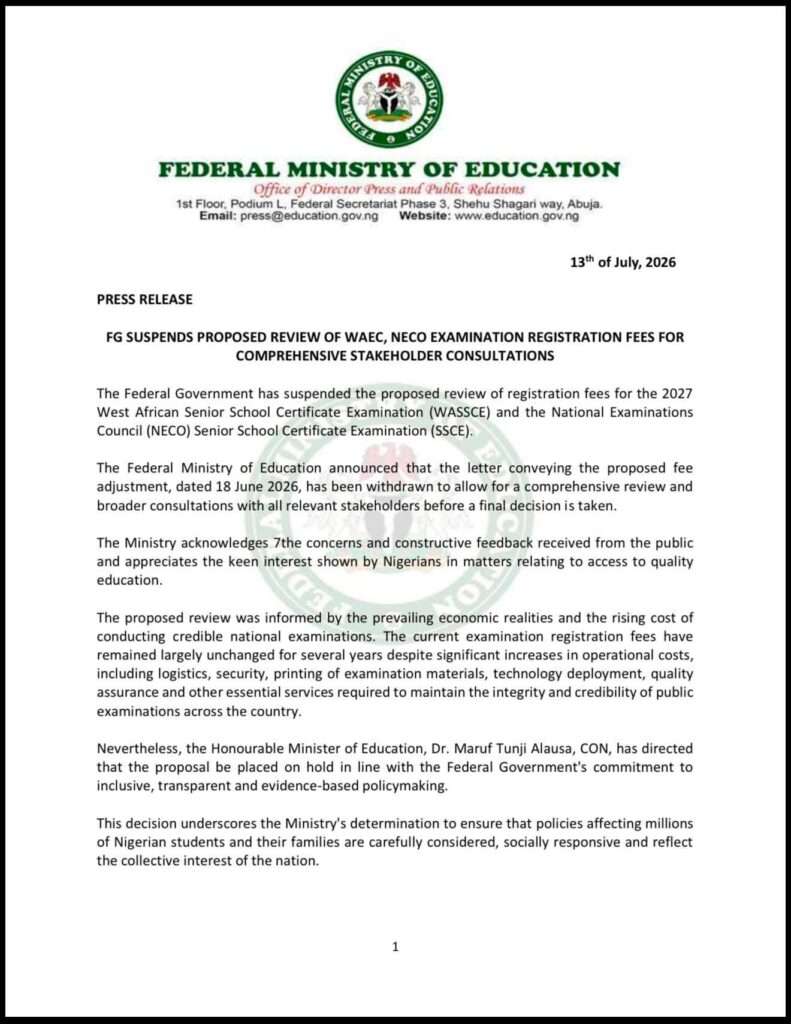
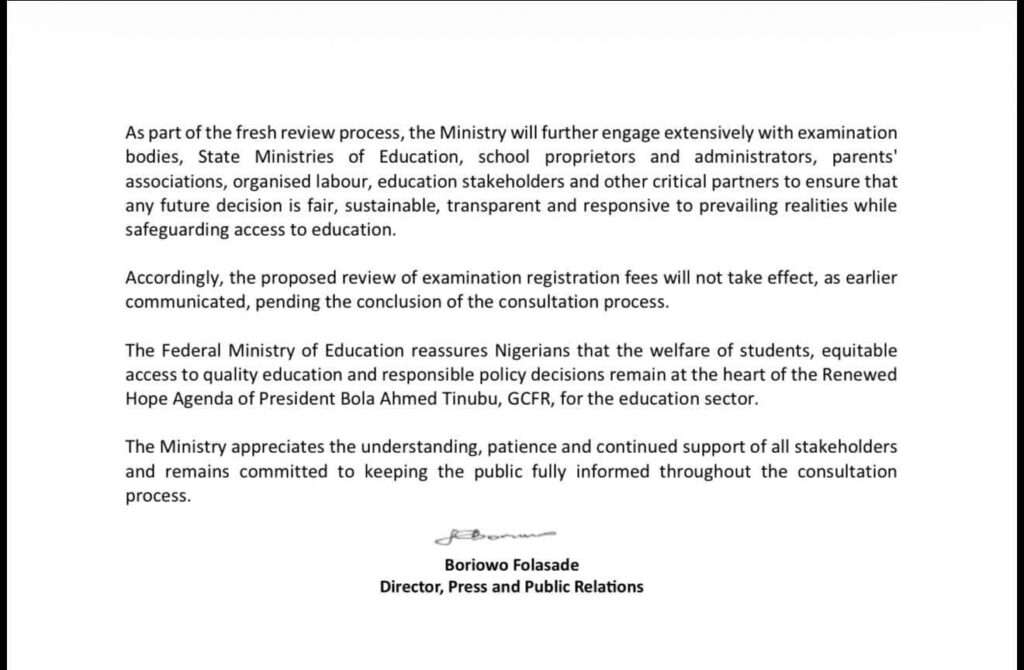
Following the nationwide backlash, the Federal Ministry of Education released an official statement on Monday, July 13, 2026. The Director of Press and Public Relations, Mrs. Folasade Boriowo, signed the document. The communication confirmed the immediate withdrawal of the June 18 policy letter.
The ministry acknowledged the constructive feedback received from concerned citizens. Officials appreciated the passion Nigerians demonstrated regarding access to affordable education. The statement clarified that the government originally proposed the review of WAEC, NECO registration fees to sustain examination standards. However, the authorities chose to prioritize social welfare over economic recovery within the education sector.
Dr. Maruf Tunji Alausa ordered the suspension to align with the Renewed Hope Agenda of President Bola Ahmed Tinubu. The minister emphasized that government policies must remain socially responsive. He noted that the administration remains committed to transparent, evidence-based, and inclusive policymaking. Therefore, the government will not implement any fee adjustment without thorough stakeholder engagement.
What the Suspension Means for Nigerian Students and Parents
The suspension of the proposed review of WAEC and NECO registration fees brings immediate relief to millions of households. Students preparing for the 2027 examination cycle can now plan their budgets with certainty.
1. Financial Relief for Low-Income Households
Parents will no longer scramble to raise N50,000 for a single examination body. Instead, families will continue paying the existing N27,500 rate. This stability allows parents to allocate their limited resources to other essential educational needs. Guardians can now afford extra tutoring, study guides, and transportation for their wards.
2. Preventative Warning to Private School Proprietors
The government’s announcement also serves as a warning to private school administrators. Some school owners often inflate official examination tariffs to generate extra profit. With the suspension clearly communicated, schools cannot justify arbitrary fee hikes for 2027 registrations. The Federal Ministry of Education has urged parents to report any institution demanding N50,000 for WAEC or NECO registration.
3. Increased Confidence in Public Advocacy
The swift reversal of the policy proves that public advocacy works. Citizens now realize that constructive feedback can influence government decisions. The suspension demonstrates that collective voices can check administrative policies. Consequently, civil society groups will likely monitor future educational policies even more closely.
The Next Steps: Broader Consultations and Future Policies
The Federal Government did not state that examination fees will remain static forever. Instead, the authorities emphasized that the review of WAEC, NECO registration fees is merely on hold pending wider consultations. The Ministry of Education plans to design a fairer policy framework through dialogue.
Comprehensive Stakeholder Engagement
The ministry will launch an extensive consultation process in the coming months. Government officials will sit down with diverse educational partners to discuss examination financing. Key participants in these upcoming meetings will include:
- Leaders of the West African Examinations Council (WAEC)
- Executives of the National Examinations Council (NECO)
- Commissioners from State Ministries of Education
- Representatives of the National Association of Proprietors of Private Schools (NAPPS)
- Leaders of the Parent-Teacher Association of Nigeria (PTA)
- Representatives from organized labor unions and student bodies
Balancing Operational Standards with Affordability
During these consultations, stakeholders must solve a difficult puzzle. They must find a way to fund credible examinations without burdening poor citizens. Examination bodies genuinely need more revenue to fight malpractice and modernize their infrastructure. However, the government cannot achieve these goals by pricing poor children out of the education system.
Several education analysts have proposed alternative solutions. First, some experts suggest that the Federal Government should increase direct budgetary allocations to WAEC and NECO. Direct subsidies would cover the rising operational costs of technology and logistics. Second, state governments could adopt policies to pay registration fees for students in public schools. Several state administrations already implement this welfare intervention successfully. Finally, examination bodies must explore innovative ways to reduce administrative waste and optimize their internal spending.
The Historical Context of Examination Fees in Nigeria
To appreciate the significance of this policy reversal, we must review the history of examination tariffs in Nigeria. Decades ago, the government heavily subsidized senior school certificate examinations. In the 1980s and 1990s, families paid token amounts to register for WAEC.
However, as the national economy evolved, subsidies shrank gradually. Examination councils began charging economic rates to sustain their operations. By the early 2010s, registration fees crossed the N10,000 threshold. In recent years, inflation and exchange rate devaluations pushed the rate to N27,500.
Throughout this timeline, every proposed fee adjustment generated public debate. Yet, the 2026 attempt to reach N50,000 caused the most intense backlash in recent memory. The sharp 82 percent jump simply exceeded the public’s tolerance level during a period of economic reform. This historical context explains why the government had to step back and re-evaluate its approach.
How Regional examination Councils Operate Globally
Nigeria is not the only country grappling with the cost of standardized testing. Across West Africa, member countries of WAEC face similar economic dilemmas. Ghana, Sierra Leone, Liberia, and The Gambia all contribute to the regional council. Each nation decides how to fund its local examination administration.
In some West African nations, the central government absorbs the entire cost of the senior school certificate examination. For example, public school candidates in certain jurisdictions write WAEC papers free of charge. The government pays the regional body directly from the national treasury.
By comparing Nigeria’s model with regional peers, educational planners can discover better funding strategies. Relying entirely on out-of-pocket payments from parents creates financial barriers. Therefore, the ongoing delay of the review of WAEC and NECO registration fees provides an opportunity to restructure the national funding model.
The Link Between Affordable Examinations and National Development
Affordable examination registration is directly linked to national economic development. Nigeria needs an educated workforce to drive industrial growth and technological innovation. Senior secondary school certificates represent the baseline qualification for formal employment and tertiary education.
If the government allows examination tariffs to become out of reach, national development will suffer. A high financial barrier reduces the number of certified graduates entering colleges, polytechnics, and universities. Over time, this deficit reduces the national talent pool.
Furthermore, youth unemployment correlates strongly with lack of educational certification. Uncertified youths struggle to secure decent jobs in the formal sector. Consequently, vulnerable teenagers become targets for illicit activities and social unrest. Keeping examination fees affordable protects national security by integrating youth into the productive economy. Therefore, the suspension of the review of WAEC and NECO registration fees supports broader national development goals.
What Parents and Students Should Do Now
While the policy remains suspended, students and parents must stay focused on academic preparation. The relief over registration fees should translate into greater commitment to study.
Verify Official School Registration Notice
Parents should maintain close communication with school administrators. When registration opens for the 2027 WASSCE and SSCE, guardians must confirm the official approved fees. If a school demands excessive amounts under the guise of council adjustments, parents should refer the management to the ministry’s recent directive.
Prioritize Early Preparation
Students must remember that examination fees represent only one part of academic success. Passing WASSCE and SSCE requires consistent preparation. Candidates should utilize the current stability to study their syllabuses thoroughly. Accessing CBT practice tools and past questions will improve candidate performance significantly.
Avoid Examination Malpractice
Examination bodies spend billions of Naira fighting academic fraud each year. When students engage in malpractice, councils expend resources on investigations, cancellations, and legal proceedings. Candidates can help reduce the operational costs of WAEC and NECO by shunning exam malpractice entirely. Clean examinations reduce administrative expenses for everyone.
Conclusion
The decision by the Federal Government to suspend the proposed review of WAEC and NECO registration fees represents a victory for responsive governance. The administration listened to the voices of struggling parents, labor unions, and educational advocates. By withdrawing the June 18 circular, the Ministry of Education prevented an avoidable crisis within the secondary education sector.
While WAEC and NECO face legitimate financial challenges due to inflation and logistics, the burden cannot fall solely on citizens. The upcoming stakeholder consultations offer a valuable platform to create a sustainable funding mechanism. Education must remain a public good accessible to all Nigerian children, regardless of their socioeconomic background.
For now, candidates and families can breathe a sigh of relief. The registration tariffs remain N27,500 for upcoming examinations. The Federal Ministry of Education has pledged to prioritize the welfare of students above all else. As the nation awaits the outcome of the new consultation process, citizens hope that future educational policies will continue to reflect compassion, fairness, and national interest.
Recommended:
Why Nigeria Postponed The WAEC CBT Exams 2026 Full Digital Rollout
FG Scraps UTME Requirement For NCE Candidates in 2026 Policy Meeting
2026 WASSCE Extortion and Why WAEC is Sanctioning Schools Over Illegal Fees