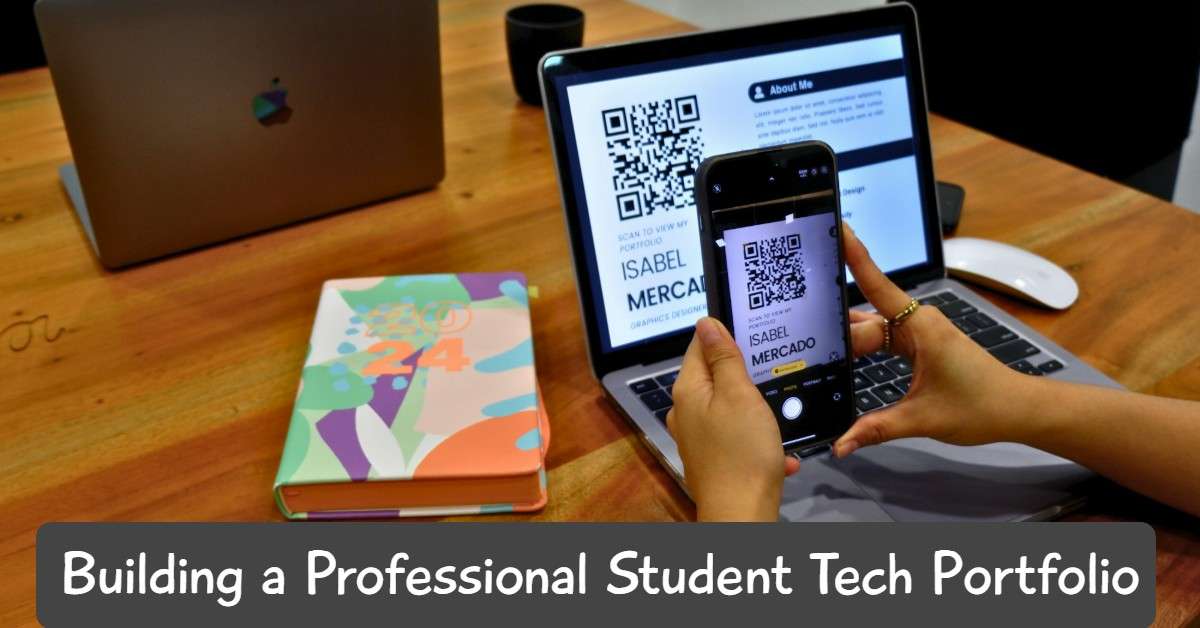
Thousands of undergraduates across Nigeria walk across the university convocation stage every year believing their degree certificate guarantees automatic employment. They pack their bags, report to their NYSC orientation camps, and eventually enter the labor market. Only then do these graduates discover a brutal corporate reality. A standard university degree is no longer enough to secure a premium job. Modern employers, technical recruiters, and international clients do not just want to know what course you studied. Hiring managers want to see verifiable, public proof of what you can actually build. It is therefore important that you start building a professional student tech portfolio before graduation.
Waiting until you finish your final semester exams to start hunting for experience is a massive mistake. Students must build their professional foundation right now, directly from their lecture hall desk. Building a robust student tech portfolio between your daily classes serves as the ultimate career cheat code. This proactive approach transforms you from a passive student into an active, highly employable professional.
This comprehensive guide will show you exactly how to stop wasting your academic effort. Readers will learn how to convert mandatory university assignments into professional case studies, master basic version control, set up a zero-cost digital landing page, and monetize a new student tech portfolio before graduation.
The Art of Repackaging: Adding Case Studies to Your Student Tech Portfolio
Transforming Academic Work into Business Value
Every semester, undergraduates invest hundreds of hours into completing mandatory coursework, running complex laboratory experiments, and drafting heavy term papers. Once the lecturer grades these assignments, the documents typically gather dust on a hidden flash drive or sit completely forgotten in a printed spiral bind. This outcome represents a massive waste of intellectual capital. Undergraduates must learn how to repackage this mandatory academic work into professional proof of competency for a student tech portfolio.
Employers simply do not have the time to read a forty-page academic thesis. Busy recruiters want to read concise, high-impact case studies. Therefore, you must restructure your academic projects using a highly specific framework containing the problem, the methodology, and the business impact.
Documenting the Process for Your Student Tech Portfolio
Consider a petroleum engineering student who spends weeks running a complex reservoir simulation to analyze wellbore instability or predict fluid recovery rates. Instead of simply submitting the final printout to the department head, that student should write a detailed technical blog post. The published post must explain the specific geological problem, detail the software methodology used (such as ECLIPSE or Petroleum Experts analytical tools), and present the final optimization solution clearly.
The exact same rule applies to cybersecurity and computer science students. If a lab assignment requires you to design a network defense architecture, run vulnerability scans using Nmap, or analyze packet traffic using Wireshark, do not just submit the raw lab report. Document the entire process from start to finish. Take high-resolution screenshots of your command line interface. Write an article explaining the initial threat model, the specific firewall configurations deployed, and how the mitigation strategy successfully blocked the simulated attacks.
Furthermore, remember to include visual evidence alongside your plain text. Export graphs from your data analysis, embed charts showing your final results, and use clear headings. By publishing these technical breakdowns in your student tech portfolio, you prove to hiring managers that you understand applied problem solving instead of just textbook theory.
Mastering the Green Grid: Using GitHub for Your Student Tech Portfolio
Understanding the Basics of Version Control
If you are writing any form of software code, maintaining a public repository is absolutely mandatory. For students venturing into software development, data science, cybersecurity, or automation, GitHub serves as the ultimate engine for a student tech portfolio. However, many students feel too intimidated to use it. Beginners mistakenly believe that they must build a massive, revolutionary software platform before they can upload anything to the internet.
GitHub is simply a version control platform. The website acts as a highly organized time machine for your code, tracking every single change you make to a script. Employers look specifically at your contribution graph. This visual element is the grid of green squares on your profile showing exactly how often you write and upload code.
The Power of Consistent Code Commits in Your Student Tech Portfolio
Uploading every single piece of code you write to this platform is essential, no matter how small or basic it seems. Did you write a basic Python calculator during a weekend tutorial? Push that script to GitHub. Have you written a lightweight background process watchdog to monitor your laptop CPU usage? Upload it immediately. Did you create a simple data visualization script using Pandas and Scikit-learn to sort through messy lab data? Add it to your repository.
Consistency matters far more than complexity in the software industry. A student tech portfolio showing consistent, weekly code uploads over two entire years looks significantly more attractive to a tech recruiter than a profile showing one massive project uploaded the day before a job interview. Frequent uploads demonstrate discipline, continuous learning, and a genuine passion for technology. Ensure you add a clean “README” text file to every single repository you create. This explanatory file should outline what the script does and how a user can run it, proving that you can communicate technical concepts clearly to others.
Constructing a Digital Headquarters for Your Student Tech Portfolio
Choosing the Right Platform for Non-Coders
Not all valuable academic work involves writing software code. An undergraduate might possess highly detailed environmental impact assessment reports, brilliant drone aerial surveillance mapping plans, or comprehensive cybersecurity audit essays. Hosting these specific documents on GitHub is highly inefficient. Therefore, non-coding creators need a dedicated, visually appealing digital headquarters.
Paying expensive web hosting fees or buying custom domains is unnecessary when building a professional website. Students can utilize platforms like Notion or Carrd to build a sleek, highly responsive landing page absolutely free of charge.
Notion functions as an incredibly powerful workspace that users can publish directly to the web with a single click. Carrd provides beautifully designed, single-page templates that anyone can customize rapidly from a smartphone or laptop. Both platforms force creators to be concise, presenting the best skills and projects in a highly scannable, mobile-friendly format that looks brilliant on any screen.
Structuring Your Student Tech Portfolio Layout
When building a digital landing page, structuring the content properly guides the visitor through your professional journey. A high-converting student tech portfolio contains three distinct sections:
- The About Me Section: Write a sharp, professional biography detailing your current degree program, your technical certifications, and your specific industry interests.
- The Featured Projects Database: This section is where you link the repackaged case studies we discussed earlier. Use bold cover images and clear, non-academic titles. Instead of naming a project “ENG405 Final Lab Report”, rename it “Optimizing Fluid Recovery in High-Pressure Environments: A Simulation Case Study”.
- The Contact and Resume Section: Provide a direct link to your active LinkedIn profile, a professional email address, and a downloadable PDF version of your standard curriculum vitae.
The Freelance Pivot: Monetizing Your Student Tech Portfolio
Leveraging Platforms like Upwork
Building a robust student tech portfolio provides immediate financial benefits long before you graduate. Once a Notion page looks professional and a GitHub graph shows consistent activity, students can execute the freelance pivot. Leveraging publicly documented projects helps secure paying clients immediately.
When pitching services on global freelancing platforms like Upwork, applicants compete against thousands of established professionals. A blank profile offering empty promises will never win a contract. However, attaching a link to a student tech portfolio showing detailed case studies of complex university projects instantly builds massive trust. A client looking for a data analyst will gladly hire the student who publicly documented a messy CSV cleanup project over an older applicant with no visible proof of work.
Pitching Your Student Tech Portfolio to Local Campus Businesses
Furthermore, freelancers can pitch directly to the local economy right outside the campus gates. The university environment is surrounded by small businesses, real estate agents, and commercial vendors who desperately need technical assistance but cannot afford expensive corporate digital agencies.
If an engineering student learned how to operate commercial UAVs and map terrain for a class project, that student can pitch aerial photography and site mapping services to local construction supervisors. If an IT student learned how to configure basic firewalls and secure internet routers, they can offer cybersecurity audits to local campus cybercafes and departmental administrative offices.
Keeping your message incredibly sharp is vital when pitching a local business owner. A strong pitch looks exactly like this:“Good afternoon. I noticed your business currently handles customer data manually on paper ledgers. I am a tech student who recently built an automated data tracking system. Here is a link to my student tech portfolio to view my past work. I can set up a similar, highly secure digital database for your shop to prevent data loss and track your inventory faster.”
This highly structured approach transforms a begging student into a valuable, competent consultant. Instead of simply handing them a paper CV, send them the link to your digital portfolio on WhatsApp. This strategy provides actual, tangible evidence of your capabilities.
Conclusion: Launching Your Career Early
The days of hiding academic efforts inside a closed university grading portal are officially over. Coursework holds immense professional and financial value, but only if students choose to display it publicly. Stop waiting for graduation, stop waiting for NYSC deployment, and stop waiting for permission to start building a career identity.
Start this weekend. Take one graded assignment from last semester and rewrite it as a professional case study. Create a free GitHub account and upload your very first Python script. Open a Notion template and draft a professional biography. Consistently adding to your student tech portfolio between classes ensures you will graduate not just with a degree, but with a powerful, revenue-generating professional brand that employers will fight to hire.
Which of your past university projects will you convert into a public case study first? Have you already set up a GitHub account, or are you planning to build your first landing page on Notion this week? Share your portfolio links, drop your freelance questions, and let us discuss your specific career strategy in the comments below!
Recommended:
Automating the Boring Stuff: A Student’s Guide to AI, Python, and Data Processing
MTN Global Graduate Development Programme 2027: The Ultimate Guide to Accelerating Your Career
Leveraging Campus Competitions for Tech Funding and Networking
Mobile Tech Skills for Students: High-Value Tech Skills You Can Master on a Smartphone in Nigeria
Prompt Engineering for Final Year Research: Decoding Complex Literature
Related posts:

Complete List of Private Universities in Nigeria (2026 Guide)

Complete List of Universities in Nigeria: A Comprehensive Guide 2026

The 2026 Tech Stack: Essential AI Tools for Students

Prof. Philip Afaha Appointed Pioneer VC of Akwa Ibom State University of Education, Afaha Nsit

Hope Arises as NUC Assures Action on NYSC Mobilisation for NOUN Graduates